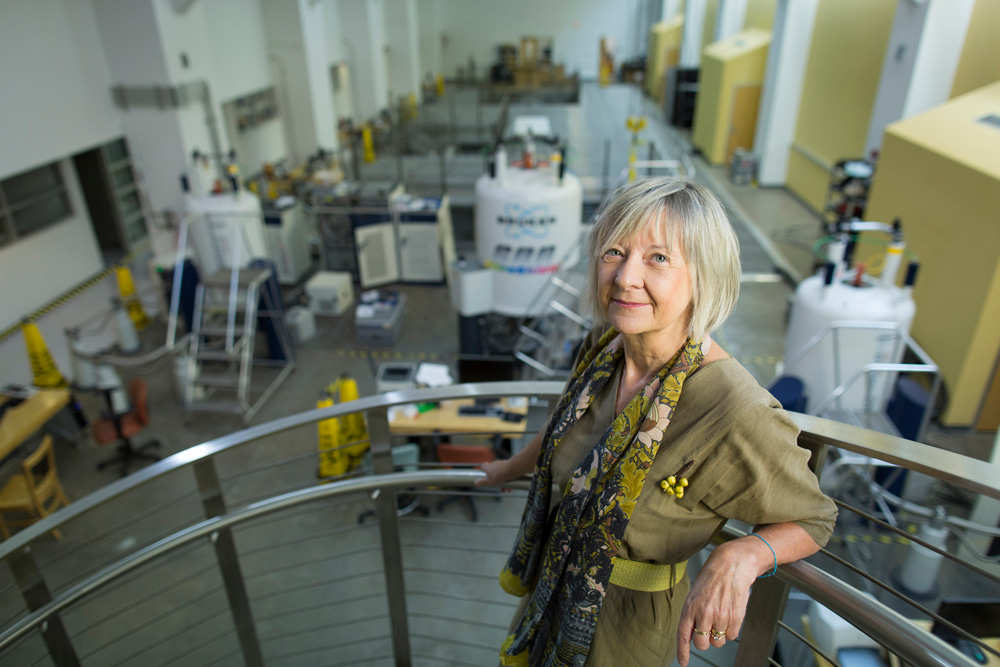
Angela M. Gronenborn: "I enjoy being confronted with a totally unexpected result..."

What drew you to your research field?
I just fell into it; and because my brother was a molecular biologist, I had someone to spar with about ideas, without worries about sounding stupid.
What do you see as the most important developments in your field in the past 10 years?
AI/ML (artificial intelligence / machine learning) approaches such as AlphaFold and RoseTTAFold have fundamentally changed the field of structural biology; we now use ML-predicted models and verify or falsify them by experiment.
What about challenges in your field?
I see democratizing structural biology as a main general task– moving it out of the hands of a few experts into those of all biologists. As understanding the structure of biological macromolecules is essential to understanding their function, this democratization is essential for progress.
What aspects of your life as a researcher do you most enjoy?
I enjoy being confronted with a totally unexpected result – this forces one to call into question any preconceived notions and ideas.
What do you consider your most important functions as a group leader?
Providing everyone with access to instrumentation, know-how and an intellectual environment to become as creative as possible.
What comes first: technique or biological question?
In my view, there is a lot of truth in Sydney Brenner’s statement: "Progress in science depends on new techniques, new discoveries, and new ideas—probably in that order". Important scientific questions always exist; however, when the appropriate techniques to address them are lacking, progress is impeded. Pursuing such questions often necessitates the development of new methodologies, and in this way, questions and techniques continually drive and reinforce one another.
What worries you about the research landscape currently?
From my perspective in the USA, we live in precarious times, and we must emphasize the importance of liberty as a precondition for the pursuit of knowledge. Freedom of scientific inquiry and public support for education are essential pillars against authoritarian rule.
Lab webpage: https://amg.structbio.pitt.edu
Two recent papers:
Bhinderwala, F. and Gronenborn, A.M. (2025) Exploiting 19F NMR in a multiplexed assay for small GTPase activity. J. Am. Chem. Soc. 147,1028–1033. https://doi.org/10.1021/jacs.4c14294
Gronenborn, A.M. (2025) Championing fundamental discovery research: quality over quantity. FEBS J. 292, 933–935. https://doi.org/10.1111/febs.17386
More information on The FEBS Journal Perham Prize Lecture at the 50th FEBS Congress
Angela Gronenborn will deliver The FEBS Journal Perham Prize Lecture at the 50th FEBS Congress in Maastricht, the Netherlands, on Tuesday 7th July 2025 on 'The awesome power of fluorine NMR – from drugs to cells'.
'FEBS Communications' posts general items from the FEBS Network Team as well as news on FEBS events and other activities.