Interview series: Meet Veronika Kočárková, a FEBS Open Bio Prize Winner

Our interviewee is Veronika Kočárková, a PhD student at the Institute of Microbiology of the Czech Academy of Sciences, Czech Republic, and a member of the Czech Society for Biochemistry and Molecular Biology. Veronika received a FEBS Open Bio speed talk prize at the 49th FEBS Congress (5–9 July 2025) in Istanbul, Turkey, for her work entitled ‘’A study of putative transcription factors in Bacillus subtilis reveals a novel mechanism of resistance to the antibiotic D-cycloserine’’.
Tell us about your research topic/work. What project(s) are you working on? What is the aim of your study?
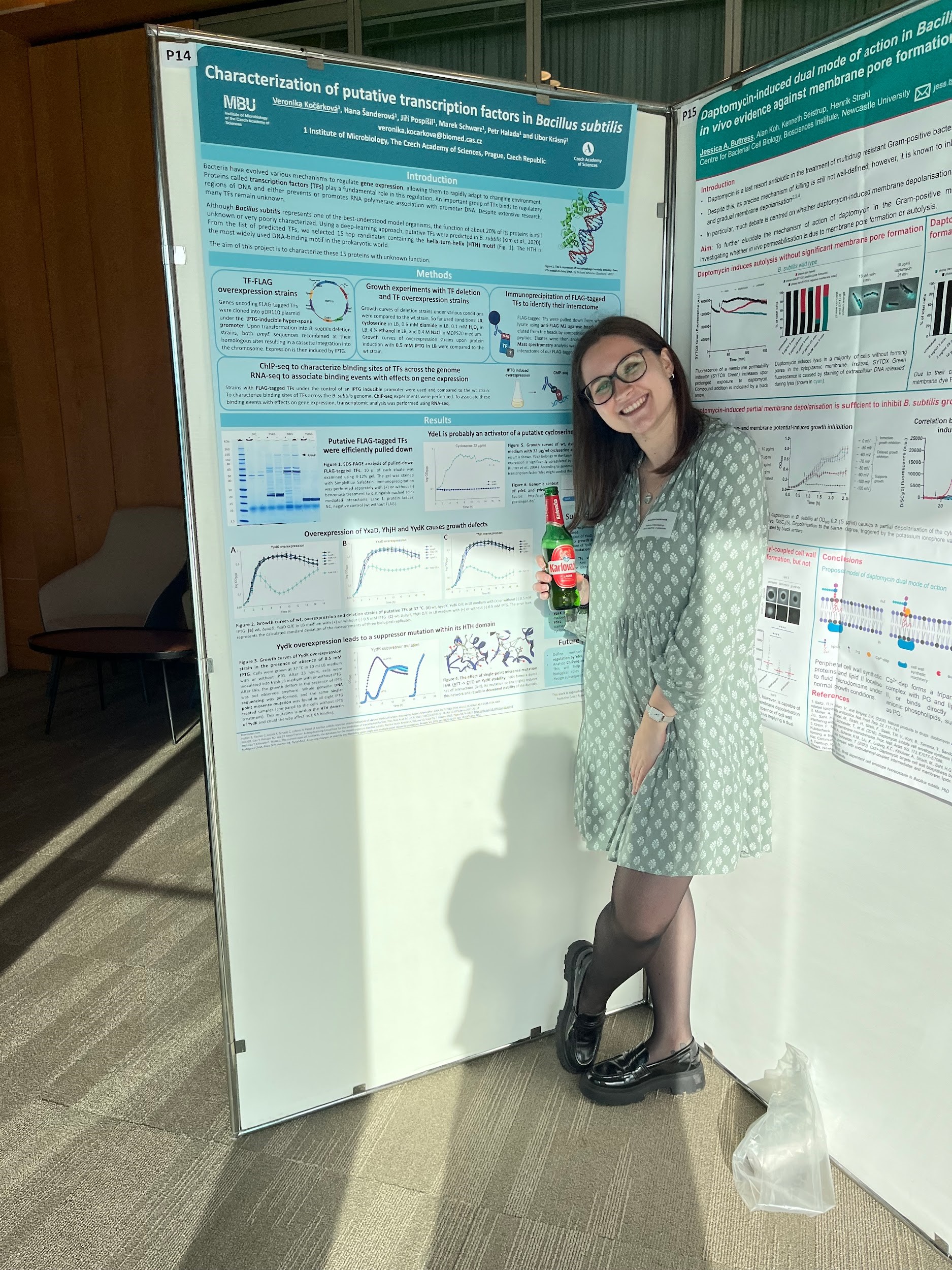
My research focuses on how bacteria regulate gene expression in order to adapt to changing environments. Bacteria are extremely successful organisms, largely because they can respond quickly to stress, such as changes in nutrients or exposure to antibiotics. This rapid response mainly occurs at the transcriptional level and is controlled by proteins called transcription factors. While extensively studied, many transcription factors are still uncharacterized, even in well-known model organisms. My work focuses on characterizing putative transcription factors in Bacillus subtilis. Recently, I identified two transcription factors and their target genes involved in resistance to D-cycloserine, an antibiotic used to treat tuberculosis. We hope that our research will contribute to a better understanding of bacterial adaptation and eventually help address challenges like antibiotic resistance.
Who or what inspired you to choose a career in science?
Honestly, I can’t point to a single person or event that inspired me. I’ve always been naturally curious, and I love learning new things. Even as a child, I was constantly asking questions and exploring the unknown. I’ve always enjoyed biology and chemistry, and I became especially fascinated by bacteria. I am amazed at how these tiny, single-celled organisms are so successful. Sometimes I even joke that they are smarter than us.
How does it feel to receive a FEBS Open Bio speed talk prize as recognition for your work? How do you see this prize influencing your career and future plans?
In a competitive field like science, it is natural to occasionally question whether your project is truly important. For me, receiving this award is valuable positive feedback, especially on days when I have doubts. At the same time, I am aware that there are many excellent projects that were not recognized. Science is not about ranking work as better or worse, and winning a prize doesn’t mean your project is inherently better.
What advice would you give to aspiring students/scientists?
I believe that in this field, it is essential to be passionate and genuinely fascinated by your research. Science can be challenging, and without that passion, it is easy to lose motivation. It is also very important to be open to collaborations. Be curious, attend seminars, travel to conferences, and discuss your research with others. These interactions can give you new ideas and perspectives. Finally, be patient and learn to see negative results as valuable information rather than failures.
Where do you envision the future of your career?
After completing my PhD, I would like to pursue a postdoctoral position abroad to broaden my research expertise. In the long term, I hope to stay in science, return to the Czech Republic, and eventually establish my own research group.