Interview series: Meet María Clara Ortolá Martínez, a FEBS Open Bio Poster Prize Winner
Our interviewee is María Clara Ortolá Martínez, a PhD student at the University of Buenos Aires - CONICET, Argentina. María received a FEBS Open Bio Poster Prize at LXI Annual Meeting of the Argentine Society for Biochemistry and Molecular Biology Research (SAIB), 27–30 October 2025, National University of Córdoba, Argentina.
Tell us about your research topic/work. What project(s) are you working on? What is the aim of your study?
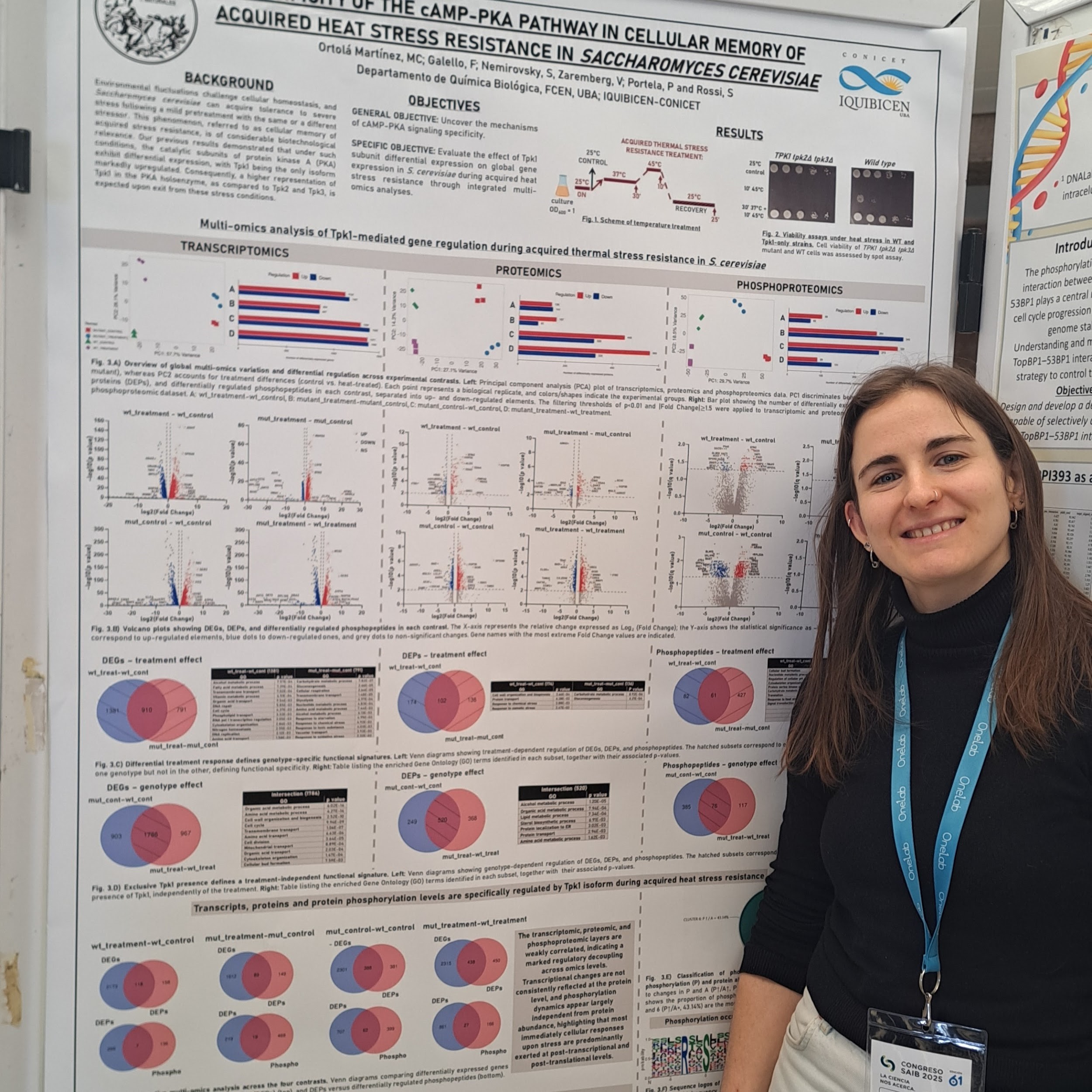
I am a molecular biologist currently completing my PhD at the Signal Transduction Laboratory: Specificity of Signaling and Cellular Adaptation to Stress at the Institute of Biological Chemistry (IQUIBICEN, UBA–CONICET), Faculty of Exact and Natural Sciences, University of Buenos Aires. My research focuses on understanding the molecular mechanisms that regulate cellular adaptation to stress, using the yeast Saccharomyces cerevisiae as a model organism.
In particular, my work centers on the cAMP–protein kinase A (PKA) signaling pathway, a highly conserved pathway that plays a central role in coordinating growth, metabolism, and stress responses. Under optimal environmental and nutrient conditions, S. cerevisiae prioritizes growth-related gene expression while maintaining low levels of stress-defense programs. In contrast, unfavorable conditions suppress cAMP–PKA signaling and activate stress-specific pathways, leading to coordinated changes at the transcriptional, translational, post-translational, and metabolic levels. This integration allows cells to mount an appropriate and context-specific stress response.
The cAMP–PKA pathway is activated by external signals that modulate intracellular cAMP levels. PKA is a holoenzyme composed of two regulatory subunits (Bcy1) and two catalytic subunits (Tpk). In S. cerevisiae, three genes encode catalytic subunits (TPK1, TPK2, and TPK3), while a single gene encodes the regulatory subunit (BCY1). Binding of cAMP to Bcy1 triggers dissociation of the holoenzyme and activation of the catalytic subunits, which then phosphorylate specific target proteins, thereby controlling a wide range of cellular processes, including aging, budding, glycogen accumulation, stress resistance, sporulation, fermentative growth, entry into the stationary phase, transcriptional regulation, and thermotolerance.
Given the broad functional scope of this pathway, a key question in the field is how PKA achieves signaling specificity in response to distinct environmental cues. Although the three catalytic subunits are functionally redundant for cell viability, accumulating evidence indicates that they perform non-overlapping, isoform-specific roles. One important mechanism contributing to this specificity is the regulation of PKA subunit expression levels, which determines the isoform composition of the PKA holoenzyme.
The main objective of my research is to investigate the transcriptional and translational regulation of the TPK and BCY1 genes as an additional layer of specificity control in the cAMP–PKA pathway during heat stress and acquired thermotolerance. We have previously provided evidence that PKA subunits are differentially expressed under specific conditions, such as nutrient limitation or stress exposure. Notably, we observed that Tpk1 protein levels increase significantly during the recovery phase following thermotolerance-inducing heat treatments, resulting in an enrichment of Tpk1-containing PKA holoenzymes. This suggests that recurrent stress promotes cellular fitness during subsequent favorable conditions.
My current work aims to further dissect the regulatory mechanisms controlling PKA subunit expression during heat stress and thermotolerance. To this end, I am applying integrated multi-omics approaches to comprehensively characterize the transcriptomic, proteomic, and phosphoproteomic networks specifically regulated by Tpk1 under these conditions. Through this integrative analysis, I aim to contribute to a deeper understanding of how signaling specificity is achieved within the cAMP–PKA pathway and how it shapes adaptive stress responses.
Who or what inspired you to choose a career in science?
I have always been a curious person with a strong interest in the natural sciences. As a child, I dreamed of becoming a marine biologist, fascinated by the ocean and especially by whales, which I found both majestic and mysterious. That early curiosity about the natural world was what first drew me toward science.
However, once I entered the Faculty of Exact and Natural Sciences, my interests gradually evolved. Throughout my undergraduate training, I discovered that what truly captivated me were the processes that take place inside the cell—and, even more so, at the molecular level. The invisible world of molecules, signaling pathways, and dynamic cellular mechanisms became increasingly fascinating to me. Understanding how life is regulated by processes that cannot be seen with the naked eye is what ultimately motivated me to pursue a career in molecular biology.
Beyond personal curiosity, I am also deeply motivated by the idea of contributing to the construction of scientific knowledge and collaborating in the collective effort to better understand the complex and wonderful world we live in. Being part of that process—asking questions, generating evidence, and sharing knowledge—has been a key driving force in my decision to follow a scientific career.
How does it feel to receive a FEBS Open Bio Poster Prize as recognition for your work? How do you see this Prize influencing your career and future plans?
Receiving this Award is truly an honor and a great source of pride for me. It is very rewarding to see my work recognized by FEBS, and it motivates me to keep moving forward in my scientific career.
This recognition strengthens my confidence and encourages me to continue exploring challenging questions in signal transduction and stress biology. I also see this Award as an important milestone that increases the visibility of my work, opens new opportunities for collaboration, and supports my future plans as an early-career researcher.
What advice would you give to aspiring students/scientists?
My advice would be to stay curious and not be afraid to pursue a career in science. Although it can be a demanding path and sometimes frustrating, it is also deeply rewarding and truly wonderful.
I would also encourage them to be patient with themselves, to embrace both successes and setbacks as part of the learning process, and to seek supportive mentors and collaborative environments. Passion, perseverance, and curiosity are key to enjoying and sustaining a career in science.
Where do you envision the future of your career?
In the future, I would like to transition from purely academic basic research toward more applied areas, where I can use the molecular biology knowledge and research experience I have gained over the years in new contexts. I am particularly interested in applying this expertise beyond academia, for example, in industrial settings such as the food or pharmaceutical industries.
I see this step as an opportunity to bridge fundamental research with real-world applications, contributing to innovation while continuing to build on a strong scientific foundation. I am motivated by the idea of translating basic biological knowledge into practical solutions with tangible impact.