The Five Divine Secrets of Life: Affinity. Concentration. Conformation. Localization. Time.

As a molecular biologist, I have spent countless hours trying to understand why certain molecules interact, why some drugs work while others fail, and why seemingly identical biological systems can produce completely different outcomes.
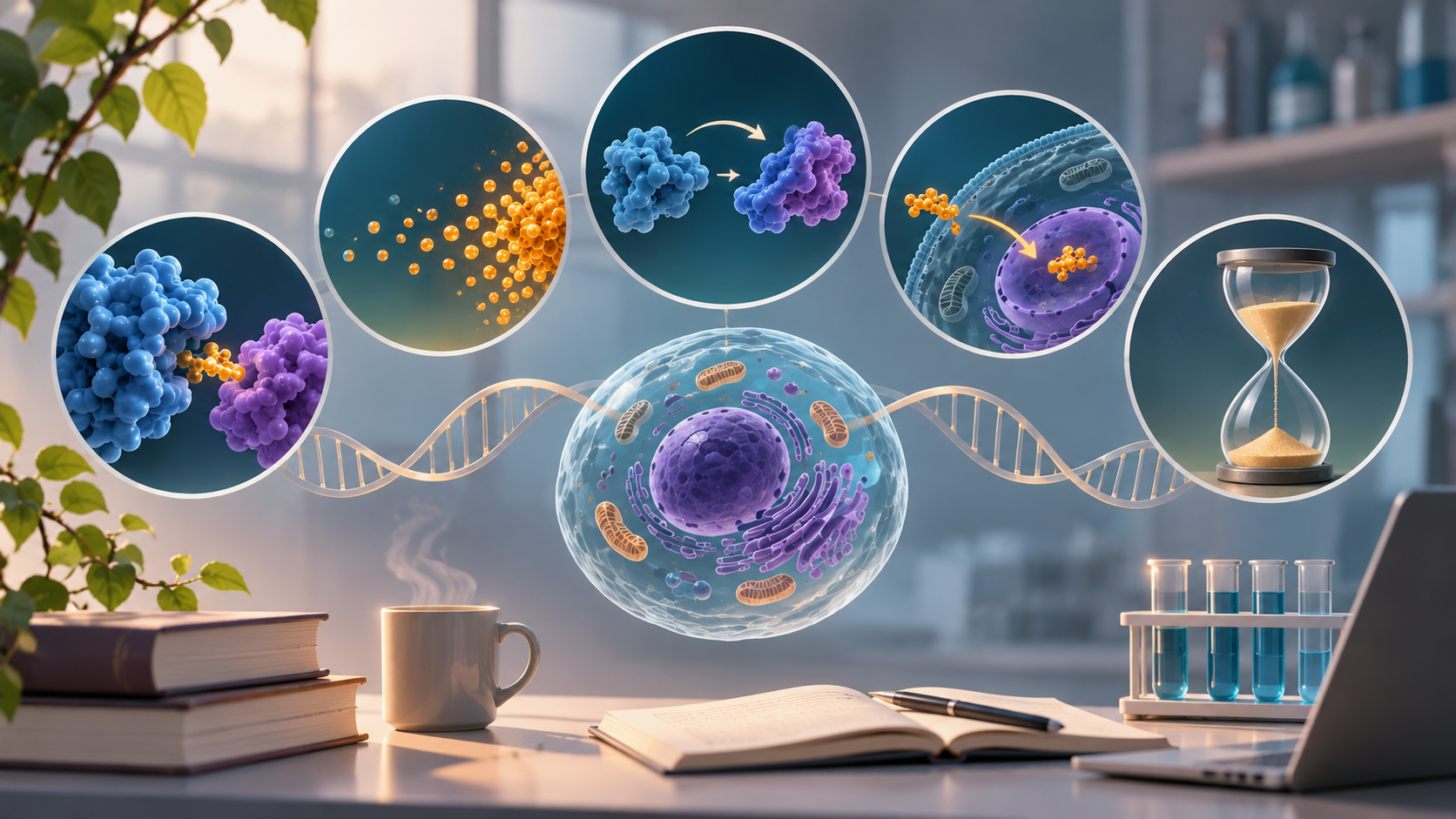
Over the years, I have found myself returning to five simple concepts whenever I try to understand a biological phenomenon: affinity, concentration, conformation, localization, and time.
Somehow, these five questions have become my personal compass for navigating the complexity of biology. But somewhere along the way, I noticed something peculiar.
These principles were not confined to my laboratory.
They were everywhere.
In ancient civilizations, human relationships, career choices, and even our daily struggles to get things done.
I like to call them The Five Divine Secrets of Life.
Affinity: Everything Begins with Attraction
In biochemistry, affinity describes the tendency of molecules attract each other. A receptor may encounter countless molecules, yet interact preferentially with certain partners.
But isn't life full of similar attractions?
Think about the ancient Egyptians. Why did one of history's greatest civilizations flourish along the Nile?
Water, fertile soil, and the resources necessary for survival attracted human settlements to its banks.
Of course, people are not proteins, and geographical preferences are not molecular binding affinities.
Yet the analogy is fascinating: we tend to move toward what sustains us.
We develop affinities for people, places, ideas, and professions.
Why does one person become fascinated by molecular biology while another falls in love with astronomy?
Perhaps choosing a research field is just another form of molecular recognition.
Concentration: The Dose Makes the Difference
Paracelsus famously taught us that the dose makes the poison.
Consider reactive oxygen species (ROS). At physiological levels, ROS participate in essential cellular signaling processes. Yet excessive ROS accumulation can overwhelm antioxidant defenses, damage cellular components, and ultimately cause cell death.
Same molecules. Different concentrations. Completely different outcomes.
Life works surprisingly similarly. A little stress can motivate us. Too much can overwhelm us. Dedication to work is admirable. Excessive dedication may lead to burnout. Even something beneficial can become harmful when its amount exceeds what we can handle.
More is not always better. Sometimes, the secret lies in finding the optimal concentration.
Conformation: Sometimes, You Need to Change Your Shape
Proteins are remarkable molecules. Their functions depend not only on their chemical composition but also on their three-dimensional structures.
A protein may possess everything necessary to perform a function, yet remain inactive until a conformational change makes that function possible.
Now imagine you need to write an important manuscript. You have the knowledge, the ideas, and the motivation. Unfortunately, you are lying on your couch, scrolling on Tiktok.
What you should do? You stand up, sit at your desk, open your laptop, and start writing.
Congratulations! You have just undergone a conformational change.
Sometimes, having the potential is not enough. You need to adopt the right conformation.
Localization: Being in the Right Place Matters
In cell biology, location is everything. A transcription factor may be perfectly functional, but if it cannot reach the nucleus, it may fail to regulate its target genes. A protein can have the right structure, the right binding partners, and sufficient abundance, yet remain ineffective simply because it is in the wrong cellular compartment.
You have finally left your couch, opened your laptop, and prepared yourself to work. But imagine trying to write it in the middle of a crowded, noisy concert. Good luck!
The same principle applies to our professional lives.
Finding the right laboratory, mentor, or scientific environment can fundamentally change a researcher's career. And let's not forget the importance of finding the right labmate! For more on that, check out Simay's article, How the Right Labmate Preserves Our Sanity.
Being the right person in the wrong place can be just as ineffective as being the right molecule in the wrong compartment.
Time: Even the Perfect Interaction Needs Time
Finally, perhaps the most underestimated variable of all: Time.
A drug may have excellent affinity, reach its target at an appropriate concentration, and interact with the correct molecular conformation. But what if its exposure is too brief?
What if it disappears before producing the desired biological response?
In pharmacology, exposure duration, elimination half-life, and binding kinetics can profoundly influence therapeutic outcomes.
But time has another interesting effect: desensitization. With prolonged or repeated stimulation, certain receptors become less responsive to the same signal.
And isn't life sometimes the same?
A song that once gave you goosebumps may lose its magic after a hundred repetitions. Even excitement can fade when we experience something too often.
Friendships take time to develop. Expertise takes years to build. Scientific discoveries require patience. Yet longer is not necessarily better.
Even the right things can become wrong when they last too long—or not long enough.
The Secret Is That There Is No Single Secret
The beauty of these five principles is that none exists in isolation.
High affinity means little without sufficient concentration. The right concentration may be useless with the wrong conformation. The perfect molecule cannot perform its intended function if it never reaches the right location. And even when everything else aligns, timing can change the outcome.
Perhaps life is not so different. We spend years searching for the right people, opportunities, environments, and moments.
Maybe success is not simply about finding the right ingredients.
Maybe it is about bringing them together under the right conditions.
The right affinity. The right concentration. The right conformation. The right localization. The right time.
Five principles that help me understand the molecular world.
And, surprisingly often, the world beyond my laboratory.