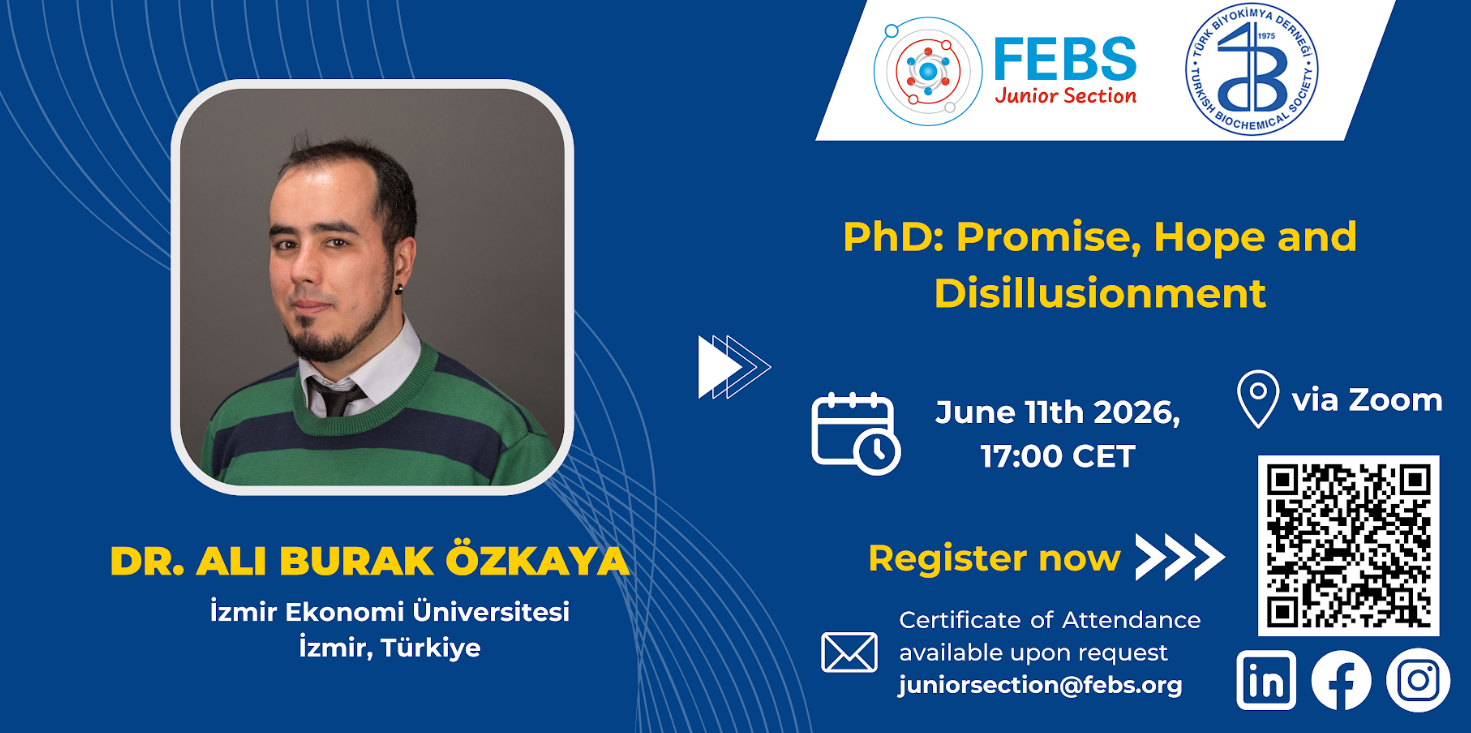
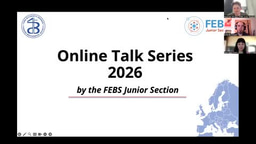
FEBS Junior Section presents Ali Burak Özkaya
Missed the event? You can watch the full recording below.
This talk is an activity from the FEBS Junior Section, an initiative set up by students and young researchers from some of the FEBS Constituent Societies. Each month members of the FEBS Junior Section organize an online event on either a research or a career topic. This talk is coordinated by the junior section of the Turkish Biochemical Society (TBS).
- Speaker’s name and affiliation: Ali Burak Özkaya, İzmir Ekonomi Üniversitesi, İzmir, Türkiye
- Title: PhD: Promise, Hope and Disillusionment
- Date/Time (CET) of the talk: June 11th 2026, 17:00 CET
Participants will have the opportunity to stay for an after-talk hangout to have an informal chat with the speaker, members of the FEBS Junior Section, and other participants.
Abstract
The modern PhD was originally designed to train future academics through specialization, research apprenticeship, and supervised original research. However, doctoral education now exists within a very different reality characterized by mass expansion of PhD programs, unstable academic career structures, shrinking public funding, and increasing pressure for universities to prioritize measurable outputs such as grants, patents, industry partnerships, and translational research.
In this talk, I will critically examine the structural tensions of contemporary doctoral education in the life sciences, arguing that many current reform efforts attempt to adapt the PhD to changing economic and institutional pressures without fundamentally questioning its historically academic foundations. I will discuss specialization, trainee labor, career precarity, and the changing role of universities within increasingly competitive and market-oriented research environments.
The talk will also reflect on broader questions about the future of academia itself: what kinds of research, careers, and scientific institutions are likely to survive in the coming decades, and what may be lost in the process.
Biosketch
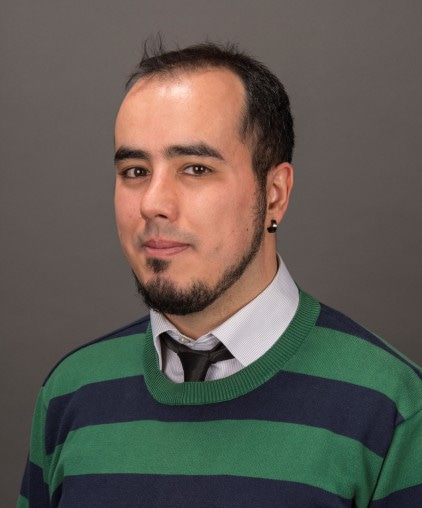
Dr. Ali Burak Özkaya is an Assistant Professor of Biochemistry at the İzmir University of Economics Faculty of Medicine, Türkiye, working at the intersection of biomedical research and higher education. Over the course of his career, he has worked as a researcher and educator in Türkiye, Germany, the United Kingdom, and the United States.
Like many doctoral researchers, his early career was shaped by the assumption that academic progression was the natural outcome of PhD training. However, difficulties securing an academic position after graduation led him to spend several years in industrial R&D before eventually returning to academia. These experiences sparked his interest in the structural tensions of modern doctoral education, particularly the mismatch between traditional academic training models and contemporary career realities in the life sciences. His current educational work focuses on critical thinking, academic culture, impact of technology, and the broader institutional assumptions underlying scientific training and higher education.