Thinking like a Scientist: the flatlander’s problem
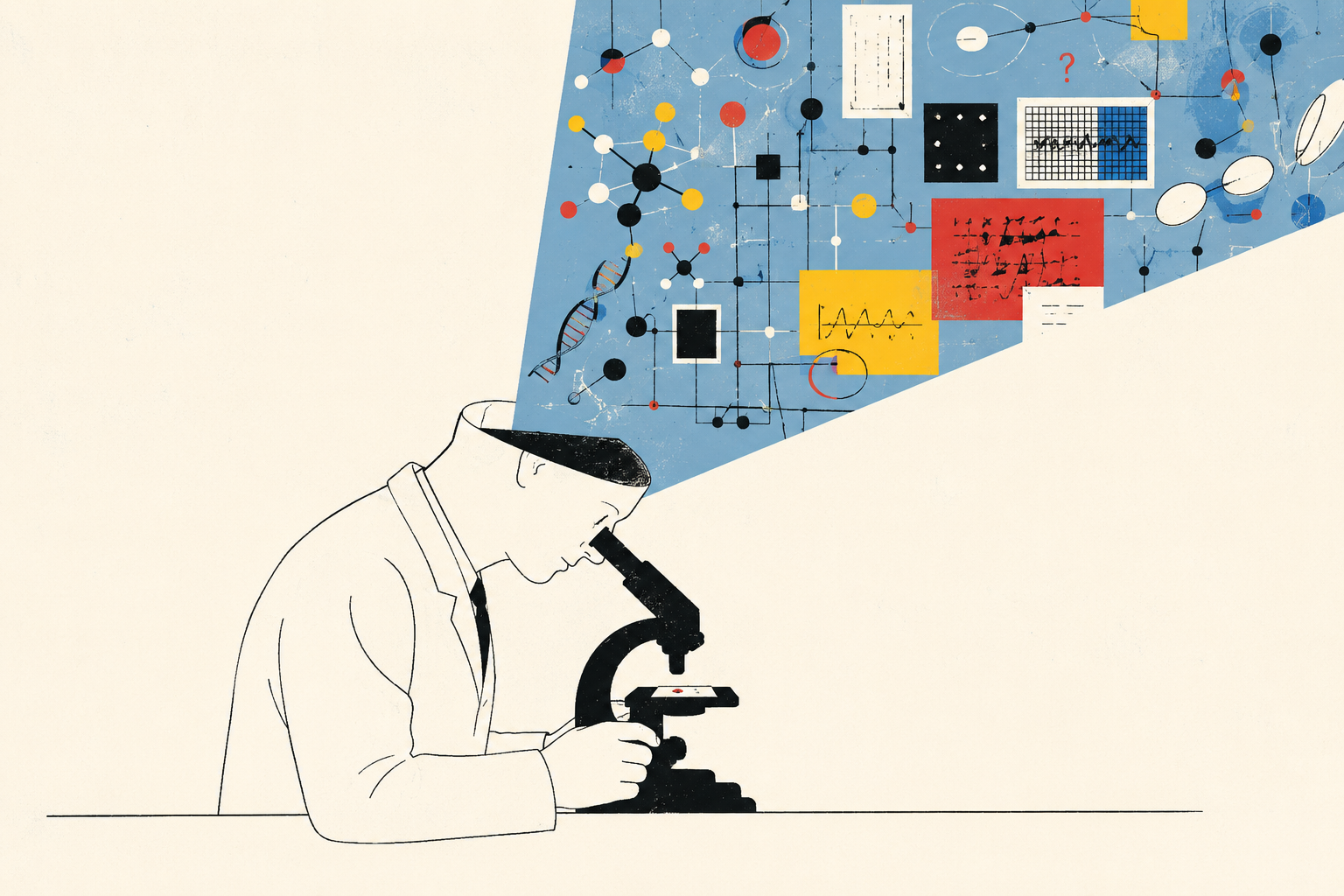

In this series, I have argued that modern biology has drifted into an arms race of data: more omics, more panels, more "resources", sometimes losing track of why we do it. We have begun letting our tools generate hypotheses for us and, in doing so, mistake prediction for deeper understanding. This epistemological mistake is compounded by removing ourselves, the observers of reality, from the picture, making it even harder to see our own biases. The obvious question is whether these are fixable habits or symptoms of something deeper in how our minds are built. Here, I will argue that they are symptoms of something deeper.
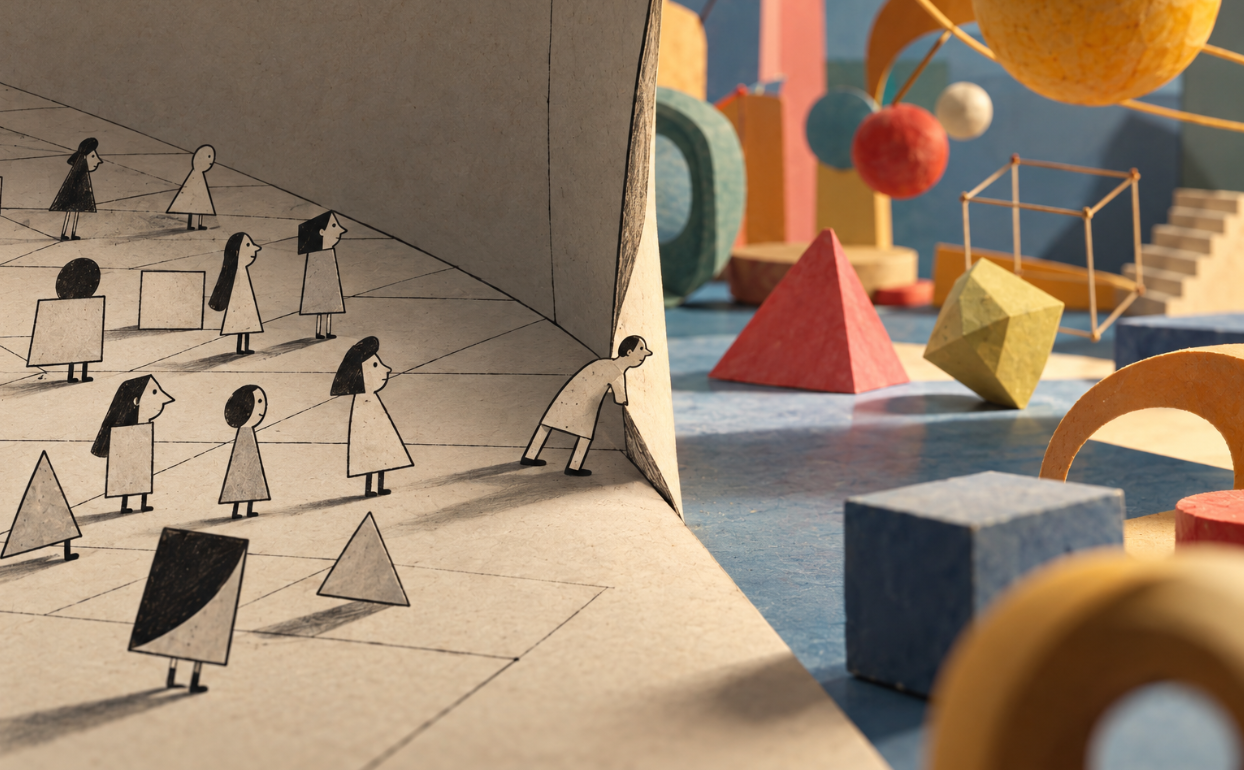
In 1884, Edwin Abbott published Flatland, a short book about a world inhabited by two-dimensional beings*. Their geometry is complete, their physics predictive, their science internally coherent. A flatlander can measure, model, and act upon his plane with everything our physics requires of a good theory. What he cannot do is see a third dimension, not because his reasoning is poor, but because the axis he would need to reason about is not an axis his mind or his world contains. The question the book leaves us with is not what a flatlander cannot know, but whether he could ever realise, from the inside, that he cannot know it.
I want to suggest that we may be that flatlander, and that the dimension we cannot step outside is not space but the predictive architecture of our own brain. In his beautiful, transformative book Being You, Anil Seth describes a current account of how the brain works. He argues that perception is a form of "controlled hallucination": the brain, which never touches reality directly, filters and interprets sensory input, then computes its best guesses about what is generating that input to help us stay alive; the hallucination is “controlled” because those guesses are continuously checked and corrected against what the senses report. We rarely notice this machinery in daily life because it draws on past experience and, importantly, memory to create a coherent narrative about our lives and ourselves. We do not merely filter reality through our senses; the mind also shapes what we perceive into the coherent framework we call reality, a framework influenced by its predictions. Thus, while in the previous article I proposed that our senses may limit our interpretation of reality, here I argue that we face an additional problem: the brain’s filtering of it all.
Karl Friston offers further insight into this prediction-machine concept. His free-energy principle proposes that a living system that persists tends to minimise variational free energy, an information-theoretic quantity that bounds sensory surprise. On this view, the brain can reduce free energy in two ways: by revising its model in light of sensory input, which contributes to perception, or by acting so that sensory input accords more closely with its predictions, which contributes to action. This second route contains the engineering impulse in its most basic form, to which I will return later.
Read on its own, though, this principle has a well-known awkwardness. A creature that only minimised surprise should crawl into a dark, silent room and never leave, since nothing there will ever surprise it. Friston himself answered this “dark room problem”: living systems minimise the surprise they expect over time, and that expectation has two parts: the pull to obtain what we predicted and the pull to find out where our model is wrong. The second part is curiosity, the value of information. A prediction machine that persists, in other words, is not one that avoids surprise but one that seeks it on its own terms. As we will see, curiosity is a key driver of our scientific explorations.
What do these arguments, which appeal more to cognitive science, have to do with science itself? Well, they likely have everything to do with science. I would like to elaborate on two points.
First, if our brain evolved to maximise predictability and reduce surprise through curiosity, science seems like the perfect human extension of that ability. Science is fundamentally based on our observations and extends our senses to explore reality. After all, science aims to predict how a system changes under variation and, indeed, to minimise surprise. With physics we predict how bodies move in space; in biology we predict what a given organism will do when subjected to a variety of stimuli. Science, at its best, is also institutionalised curiosity. Seen from this perspective, science fits the description of an extension of the brain’s modus operandi. If the prediction-machine hypothesis is correct, our brain may have evolved to filter and simplify reality into predictable units, and science epitomises this view. With the recent explosion of science and research, we are building what philosopher Jean Baudrillard termed “hyperreality”: a condition in which a simulation or model replaces the reality it was meant to represent. In our context, we are building a highly sophisticated and computationally self-consistent surrogate of nature so convincing that the map precedes the territory, and we risk mistaking the representation for the raw terrain itself. A further extension of our need to control and predict is the advent of AI, through which the integration of huge amounts of information gives us the impression that we now have full control of reality. I wonder whether this delusion, enabled by our ability to represent reality through science, will eventually reduce our true adaptability to nature, not because our models are wrong, but because we stop wanting to be surprised by them.
I recently came across a striking case in point. In July 2025, at xAI, Elon Musk deleted the term “researcher” as a job title because using “researcher” and “engineer” is only a “thinly-masked way of describing a two-tier engineering system”. This left me puzzled but at the same time made me realise that this trend underlines humans’ desire to control life by engineering it, the apex of the prediction machine. I see this as a sort of human arrogance, where the ability to engineer life gives us the illusion of understanding it and controlling it. And the reaction was telling: Yann LeCun warned that abolishing the researcher role “will kill innovation”, which is precisely my worry. A company that removes the people whose job is to model the world, in favour of those who act on it, may have simplified itself further than it realises.
The other point, following from the previous, is how to explore nature and reality in a non-circular way, i.e. not simply expanding on the dimensions that we can grasp. For this point, we should go back to the incredible story of Flatland. For the main 2D characters, A. Square, science would work perfectly well; it might predict motion and construct reality, yet how would they know the world could actually be 3D? The temptation is to answer: by reasoning. Yet the story already shows how tricky that answer is. Before the sphere ever arrives, A. Square dreams of visiting Lineland, a one-dimensional world, where he tries to explain the second dimension to its King. The King cannot conceive of it, perceives A. Square only as points on a line, and tries to silence him. Then A. Square wakes, a 3D sphere comes for him, and he is exactly as blind as the King he had just condemned. The lower world is always obvious; the higher one, unthinkable, and we are no exception. Because A. Square, the flatlander, does not reason his way to the third dimension. Only when shown the view from above does he understand the world he had been inhabiting. He could not have guessed his way there from inside. The instrument of his escape came from outside the system he was trying to understand. When applied to us 3D dwellers, our science faces the flatlander’s problem in full: internally coherent, predictive, complete within its own dimensionality, but blind to the axis it cannot represent.
We now describe life at a resolution that would have been unimaginable a generation ago: whole-cell models, spatial omics, single-cell atlases, and the temptation, precisely because the models are so powerful, is to mistake a model we can act on for the world itself. The illusion of hyper-reality is not that our science is too simple. It is that our ability to engineer life convinces us we have understood it, when what we have done is build a model coherent within the dimensions we happen to occupy. This is quite a circular argument, though, since we are the ones who explored the dimension itself based on our prediction machine: the brain. Things work because we made them work through our reasoning and tools; we constructed a self-serving reality! The value of the Flatland story is that it names the discipline we actually need: not more confidence in the models we have, but a permanent suspicion that somewhere out there is an axis we cannot yet see, and the humility to build the instruments that might, one day, lift us far enough out of our own plane to notice it. The instrument most often proposed for that lift is, today, AI, though I have my doubts. For even a genuine sphere could not be trusted: from inside the plane, a revelation can only arrive as testimony, never as something we can independently check. The real escape may be another flatlander, many beings triangulating an object none of them can see. And the book itself warns us against expecting more: when A. Square, his mind freshly opened, asks the sphere whether a fourth dimension might exist, the sphere rejects the idea out of hand. Even the visitor from above is a flatlander to something, trapped one rung up the ladder with no view of what lies beyond. I will end with a critical question to probe AI's power to be our sphere: Would a 2D-based AI model of reality predict a 3D one?
Prompted by curiosity, I put the question to an AI. Here is the answer it gave me: I have no more access to reality than you do — I have text, which is a projection, a set of 2D shadows of a world neither of us touches directly. I can extend and recombine what’s latent in that corpus. I cannot conjure an axis that was never written down. So: would I predict a 3D one? Only to the extent the third dimension already left its shadow in everything I was trained on. If it did, I might help you notice it — but I would not be the thing that brings it in from outside.
* As a personal note, I learned about this book from Prof. Stefano Moro, one of the greatest professors I have had the pleasure of meeting when studying Medicinal Chemistry in Padova. He showed me that science is more than mere learning and research.
** Much of human suffering arises when reality doesn’t meet our expectations. I wonder whether anxiety evolved to help humans perceive the discrepancy between reality and the model in our brain.

Our lab uses genetically modified mouse models and a combination of cell biology, molecular biology, and biochemistry techniques to study the role of altered mitochondrial dysfunction and metabolism in human diseases. A primary analytical tool of the group is metabolomics, which enables the parallel quantification of hundreds of small molecule metabolites. The team also uses computational approaches to integrate datasets from multi-dimensional analyses, including metabolomics, proteomics, and transcriptomics, with the aim to model aging-related disorders and to generate mechanistic hypotheses that will be cross validated experimentally.