Thinking like a Scientist, Part Six: Science’s Blind Spot

In the previous article, I argued that the burden of knowledge increasingly challenges scientists in deciding what questions to ask and how to navigate their fields. That burden helps explain why individual researchers find it difficult to enter a field and grasp its complexities. It has also been invoked as a possible cause of scientific stagnation. Why, despite enormous resources, advanced technologies, and vast amounts of knowledge, does the scientific system appear to be producing fewer genuine conceptual breakthroughs? Is it the burden of knowledge alone or is there something else?
A recent piece in Nature reported that, across millions of papers and patents, science and technology appear to be becoming less disruptive over time. Its authors linked this decline partly to the previously discussed burden of knowledge: “scientists and inventors require ever more training to reach the frontiers of their fields, leaving less time to push those frontiers forward”.
That diagnosis may be relevant, but I want to push it one step further. The problem is not only that modern science contains too much knowledge to master. Science also naturalises the conceptual categories through which facts are filtered. Successful concepts become so familiar, so embedded in methods, instruments, funding structures, and training, that they stop looking like concepts at all.
The same accumulation that makes a field harder to enter also makes its dominant categories harder to question once one is inside it, possibly limiting the so-called “paradigm-shifting” discoveries. To make that point, I want to begin with a talk I attended recently, which helped me crystallise these ideas.
The lens of Science
The speaker was Martin Chalfie, a Nobel laureate known for his discovery of Green Fluorescent Protein (GFP). Contrary to what I had expected, he spent most of his time explaining how scientific discoveries are made and how we might become better at making them. He began with a paper by Abraham Flexner [1], written almost a hundred years ago, on how discoveries once considered useless can become valuable to future generations. That framing set up the rest of the talk, which focused on the importance of basic science and on how to create conditions for groundbreaking discoveries.
For me, the ending of the talk was the most relevant part. Chalfie asked how we can become better at making new discoveries. His answer was surprisingly simple: we need to 'question what is right in front of us' and 'question our assumptions'. To illustrate the first point, he used the example of the cornea. It is transparent, always present, and yet we hardly notice it, even though it filters everything we see. Sometimes we miss what is right in front of us precisely because it fits so naturally into our way of thinking. To illustrate the second point, he guided the audience through small puzzles that showed, almost embarrassingly, how often hidden assumptions prevent us from seeing what is there and from finding solutions to simple problems.
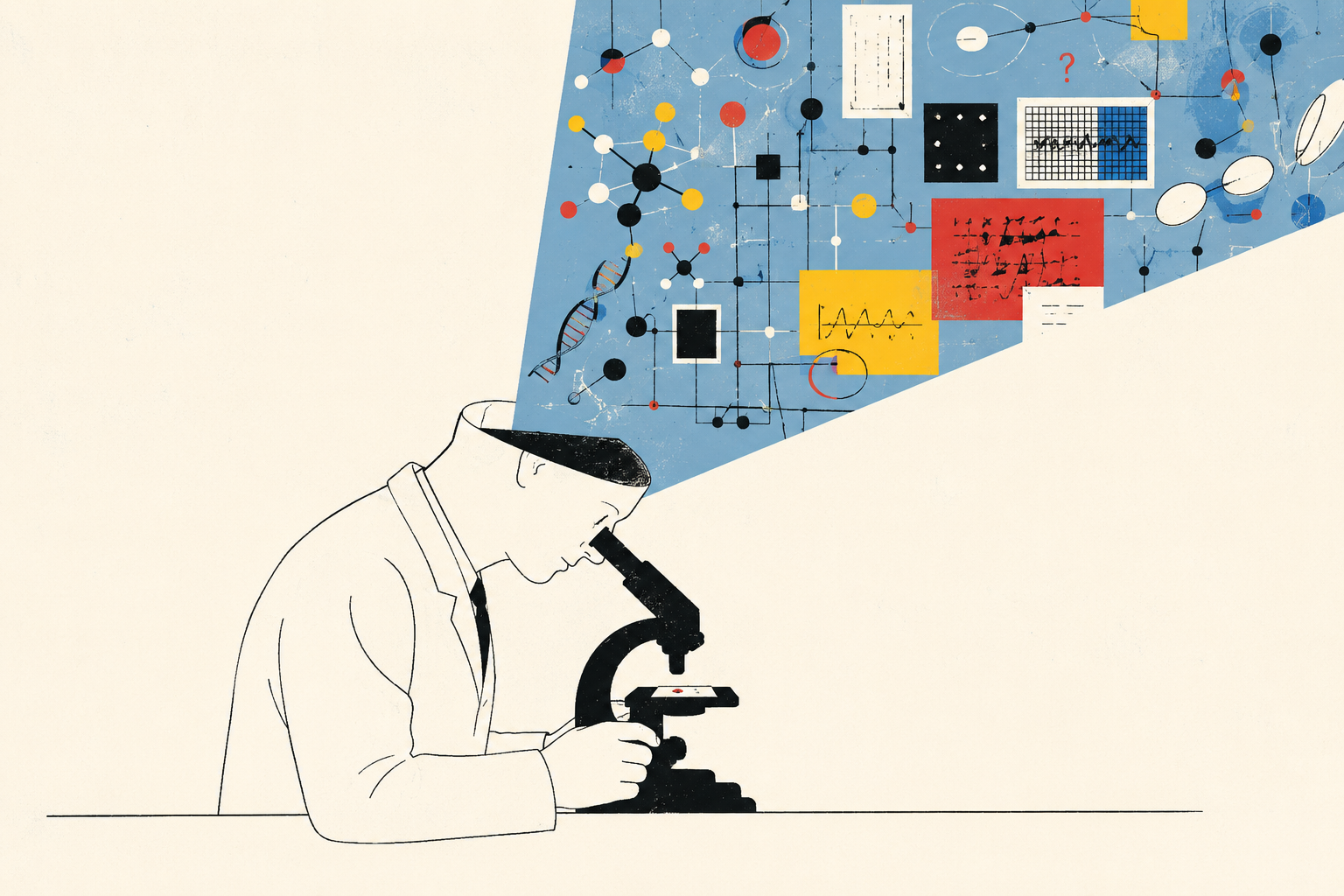
That deceptively simple advice highlights a deeper issue. How do we question what is in front of us? How can we question our assumptions? This is easier said than done. Science can become blind to the conceptual lenses through which facts become visible in the first place. Some of our most fundamental assumptions are embedded in the very concepts and methods we use to understand the world. They are hard to question because they do not appear as objects in front of us. Rather, they are the conditions that make certain things visible and intelligible within scientific practice. They become our cornea. This is not a criticism of science itself, but a call to resist treating any one scientific vocabulary as inevitable, and to keep alive the kind of methodological pluralism that Feyerabend defended against “the tyranny of science”.
The Gene as a Lens
To see how this works in practice, consider one of biology's most productive concepts: the gene. The gene did not always exist, conceptually, as the tangible object we often imagine today. Mendel inferred “heritable factors” from the segregation patterns of plant phenotypes. Then Morgan and Sturtevant mapped such factors onto chromosomes, giving the concept a physical location. The term 'gene' was eventually coined by the Danish botanist and geneticist Wilhelm Johannsen.
The elucidation of the double helix revealed the structure of DNA, and later work progressively tied the gene to a molecular substrate. The central dogma then framed biological information as flowing from DNA to RNA to protein. The very label 'dogma' is worth pausing on: it gestures at precisely the kind of assumption this piece asks us to challenge.
At this point, the gene became a real, manipulable object, something one could locate, sequence, modify, and count. In some accounts, it even became a selfish entity with a teleological purpose [2].
When the Lens Becomes the World
This shift was extraordinarily productive. It helped spark the molecular biology revolution, leading to recombinant DNA, PCR, sequencing, transgenic animals, and an entire biotechnology industry. Yet turning the gene into a concrete, manipulable entity also carried risks. Cancer is a useful example because it shows how a powerful explanatory object can survive even as the phenomena it explains become more complex. In the 1960s and 1970s, the discovery of oncogenes and tumour suppressor genes produced an enormously fruitful picture: cancer as a disease of mutated genes. Each tumour seemed to have its culprit, and finding that culprit appeared to reveal the path to a cure. As a student, I found this beautifully simple and powerful. Now, less so.
As evidence accumulated, anomalies emerged. Rather than a single mutated gene, cancer requires a complex combination of alterations that varies by tissue of origin. The same driver mutation can behave differently depending on the tissue in which it appears. Mutations labelled as 'passengers' sometimes matter in particular contexts. Tumours evolve under therapy, adapt to selective pressure, and escape from treatments designed to target specific molecular lesions. Mutations associated with cancer are even found in apparently normal tissues.
These findings did not make the gene-centred framework collapse. Instead, the framework adapted. The unit of explanation became the pathway, then the tumour microenvironment, then the clonal ecosystem and its evolution. None of these moves was wrong; each was a real advance. But notice what happened along the way: the gene-as-object was preserved, while its explanatory role was progressively diluted and redistributed.
Cancer is still often described as a disease of the genome, even as many scientists investigate tumour ecology, metabolism, mechanics, immune contexture, developmental plasticity, epigenetics, spatial organisation, and systems biology [3]. My point is not that contemporary cancer biology is naive or simply reductionist. It is that even its most pluralistic versions often retain genomic categories as the default organising grammar, treating genes as the privileged explanatory objects to which other levels of organisation are recruited.
This is also reflected in the continued reliance on mouse models of cancer, many of which are generated using specific genetic alterations, even though these models often fail to recapitulate key aspects of human disease.
The recent enthusiasm for single-cell atlases further illustrates this. Having recognised that cancer and its environment are highly heterogeneous, and armed with single-cell sequencing, we often assume that we will solve its mysteries once we have mapped each component in sufficient detail. Single-cell atlases are extraordinarily powerful descriptive tools. The trouble lies in expecting sufficient resolution, by itself, to solve the conceptual problem. Higher resolution does not automatically generate better concepts. We already know that the maps these atlases build are not the territory. Knowing cellular composition in detail may not necessarily help us understand the landscape of cancer unless we also rethink what counts as an explanatory unit, a causal relation, or a meaningful state. These analyses may instead reveal a form of complexity that we mistake for controllable knowledge once the right computational tools arrive.
In other words, we keep looking for explanations of the paradoxes created by a gene-centred view of biology by digging deeper, hoping that greater reduction will eventually come to the rescue, rather than revisiting the assumptions that made those paradoxes visible in the first place [4]. This, I believe, is what Chalfie's cornea example helps us see.
In cancer biology, we often filter the disease through the lens of the 'gene' without fully questioning that lens, even when paradoxes and experimental anomalies accumulate. The blind spot is structural, not only a matter of individual bias, though that matters too.
The more successful a paradigm becomes, the more its categories disappear as categories, making it harder to see what they exclude. As I discussed earlier, the weight of accumulated knowledge makes it harder to enter a field. But this deeper blind spot makes it even harder, once inside, to step back and see the field from the outside.
Finding the Box
A recent book by Adam Frank, Marcelo Gleiser, and Evan Thompson, The Blind Spot, shows the broader implications of this kind of trap. They argue that modern science tends to remove us from the picture of the world we are creating, even though we are essential observers of it. What we investigate are not raw objects but constructs, shaped by our practices of observation and characterisation. The blind spot I have been describing here is a specific case of the larger cognitive problem they identify. Their framing is broader and more philosophical than mine, but the direction is the same.
We are often told to question our assumptions, to 'think outside the box'. The trouble is that we sometimes do not know where the assumptions are: where is the box? Perhaps the next important step is not simply to generate more data, build larger atlases, or refine existing tools, but to ask what our most successful concepts make invisible. Finding the box may require returning to anomalies, comparing alternative conceptual frameworks, and treating our most useful abstractions not as mirrors of reality, but as tools that both reveal and conceal. Only then can we begin to see what has been right in front of us all along.
Endnotes
[1] The Flexner quote comes from Abraham Flexner's 1939 essay 'The Usefulness of Useless Knowledge'. In this piece, Flexner writes that 'most of the great discoveries which had ultimately proved to be beneficial to mankind had been made by men and women who were driven not by desire to be useful but merely the desire to satisfy their curiosity'. Martin Chalfie's lecture is available on YouTube.
[2] This refers to Richard Dawkins's selfish gene hypothesis, which effectively reified genes as active agents and framed bodies as 'survival machines' built to propagate DNA. The view is contested, but it shaped how a generation of biologists thought about agency and selection, and it reinforced the reification described in the rest of this piece.
[3] As Lakatos observed in his work on research programmes, scientists do not usually abandon a theory the moment facts appear to contradict it. Instead, research programmes often absorb anomalies through auxiliary hypotheses, methodological adjustments, or shifts in emphasis. The gene-centred framework is a striking example: the anomalies accumulated, but the core object held.
[4] The question of why scientists appear to thrive in this setting, and what institutional and incentive structures keep them working within the dominant framework, will be discussed in a later piece.

Our lab uses genetically modified mouse models and a combination of cell biology, molecular biology, and biochemistry techniques to study the role of altered mitochondrial dysfunction and metabolism in human diseases. A primary analytical tool of the group is metabolomics, which enables the parallel quantification of hundreds of small molecule metabolites. The team also uses computational approaches to integrate datasets from multi-dimensional analyses, including metabolomics, proteomics, and transcriptomics, with the aim to model aging-related disorders and to generate mechanistic hypotheses that will be cross validated experimentally.