Collaboration between FEBS Junior Section and FEBS Press: Meet the 2026 Junior Ambassadors
The Junior Ambassador Initiative - a collaboration between FEBS Junior Section and FEBS Press - continues advancing to the second stage. The Junior Ambassadors are early-career researchers and members of the FEBS Junior Section, selected to represent the FEBS Press journals. During their ambassadorship, they have an opportunity to connect and work closely with the Editorial Office teams and raise awareness of the journals by organizing engaging activities.
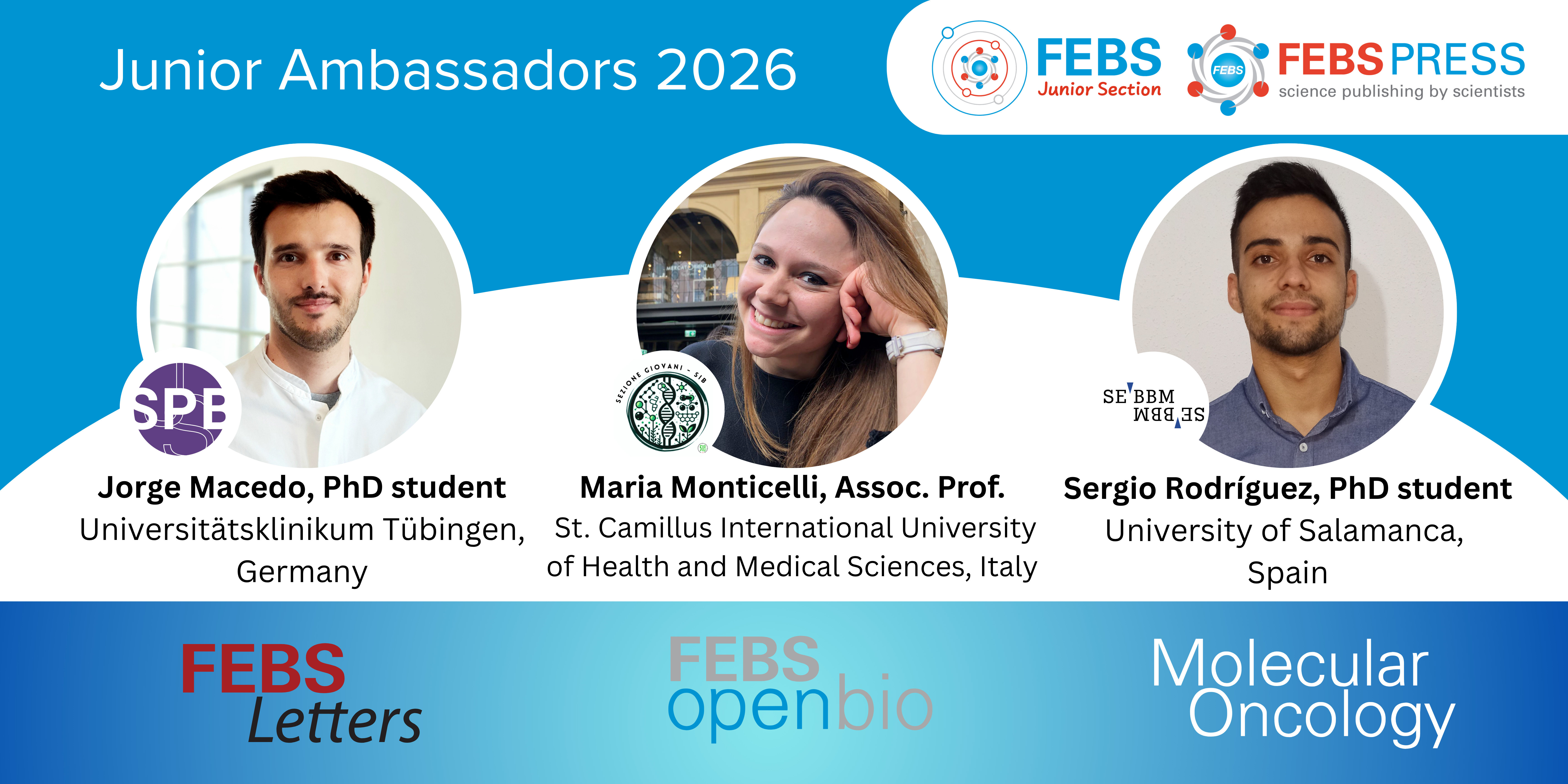
We are happy to announce and introduce the Junior Ambassadors for 2026.
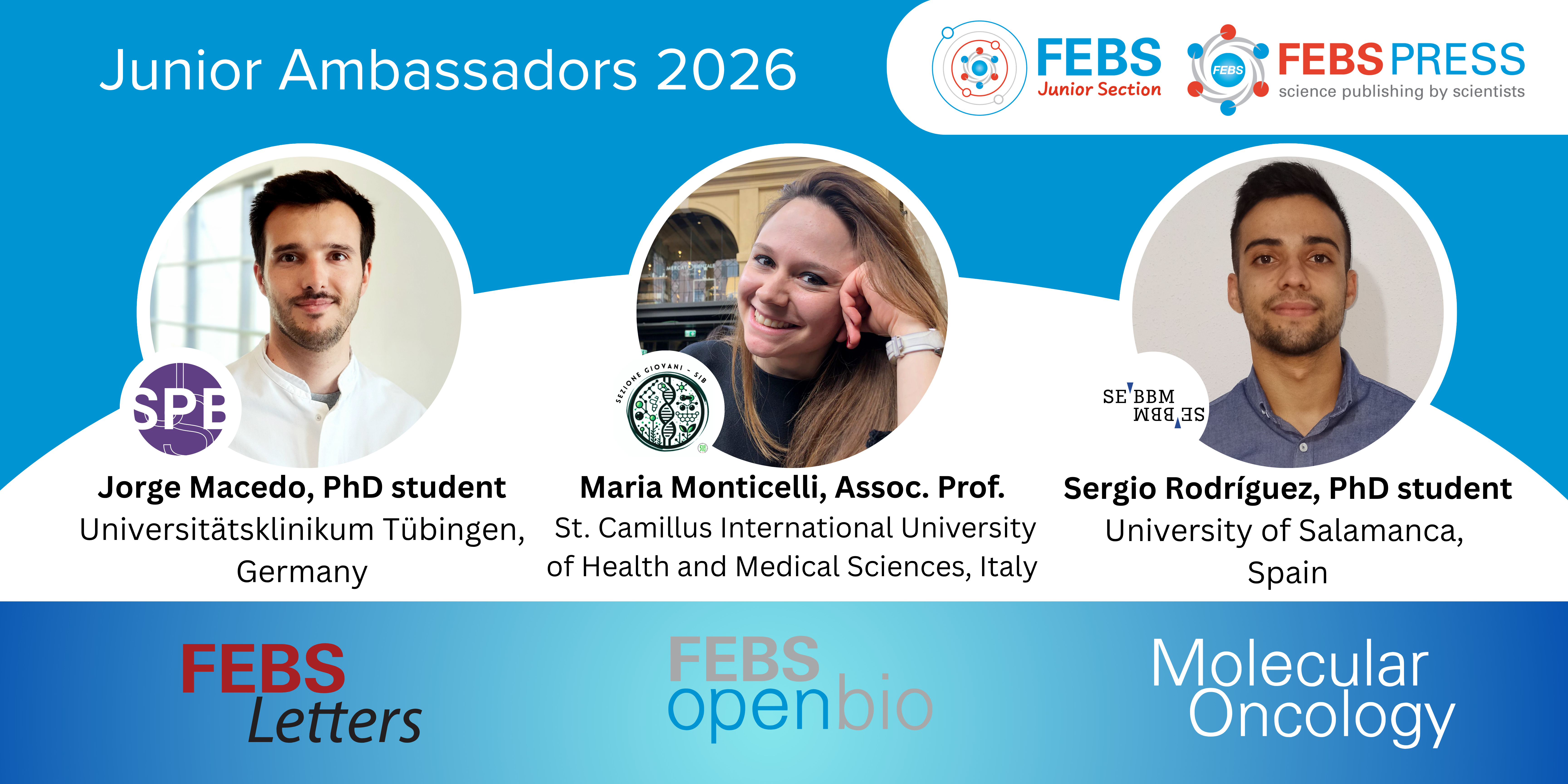
Junior Ambassador for FEBS Letters
- Jorge Macedo, PhD student at the Universitätsklinikum Tübingen, Germany, will represent FEBS Letters. Jorge is a member of the Portuguese Biochemical Society, SPB, and a member of the SPB Junior Section. His research focuses on oncoimmunology, investigating how therapy-induced senescence in cancer cells shapes the tumor microenvironment. His work aims to uncover the mechanisms by which senescent cancer cells suppress immune activation and to identify novel therapeutic targets to restore anti-tumor immunity.
Why did you choose a specific journal to represent? - I chose FEBS Letters because it offers a unique opportunity to represent a well-established non-profit scientific journal whose activities support a wider scientific community. I was particularly impressed by the freedom to develop and implement my own initiatives, allowing me to engage my creativity to promote and share science.
What do you hope to achieve through this experience? - The opportunity to gain insight into scientific publishing from the inside was especially appealing, as it provides a better understanding of the editorial and publishing process. In addition, I would like to build meaningful connections within the FEBS community while contributing to the visibility and outreach of FEBS Letters, and gain experience that will be valuable for my future career.
Junior Ambassador for FEBS Open Bio
- Dr. Maria Monticelli, Associate Professor at the Saint Camillus International University of Health and Medical Sciences, Italy, will represent FEBS Open Bio. Maria is a member of the Italian Society of Biochemistry and Molecular Biology, SIB, and its Junior Section, Young-SIB. Her research focuses on missense mutations associated with rare diseases. By combining classical biochemistry, structural biology, and cellular models, she aims to elucidate pathogenic mechanisms and identify opportunities for therapeutic development and drug discovery.
Why did you choose a specific journal to represent? - I chose FEBS Open Bio because I appreciate its broad scope and its open-access approach. My research brings together different areas, from biochemistry and structural biology to cellular models, so I felt that the journal was a good fit with the way I work and think about science. I also liked the idea of representing a journal that makes research accessible to a wide scientific community.
What do you hope to achieve through this experience? - I would like to actively contribute to the FEBS Press community and help increase the visibility of FEBS Open Bio, especially among young and early-career researchers. I think this role is a great opportunity to bring the journal closer to the scientific community, encourage researchers to engage with its content and initiatives, and help create new connections within the FEBS network.
Junior Ambassador for Molecular Oncology
- Sergio Rodríguez, PhD student at the University of Salamanca, Spain, will represent Molecular Oncology. Sergio is a member of the Spanish Society for Biochemistry and Molecular Biology, SEBBM, and its Junior Section. His research focuses on elucidating the regulatory mechanisms of DNA replication that underlie cancer biology. Specifically, his work investigates the dynamic ubiquitylation and deubiquitylation of PCNA during unperturbed DNA replication, aiming to provide mechanistic insights that may inform the development of therapeutic strategies targeting replication-associated processes.
Why did you choose a specific journal to represent? - As a PhD student at the Cancer Research Center in Salamanca, I chose Molecular Oncology with a dual purpose: to broaden my scientific knowledge and gain a deeper understanding of cancer biology, and to introduce and promote among my colleagues a high-quality, non-profit scientific journal that is accessible to researchers at all career stages, from early-career scientists to senior researchers.
What do you hope to achieve through this experience? - I hope that this Junior Ambassadorship will allow me to develop a valuable set of skills, particularly in scientific communication, event planning and organization, and manuscript preparation. I also hope to strengthen my ability to engage with the scientific community and contribute to fostering greater awareness of and engagement with Molecular Oncology among early-career researchers.
We warmly congratulate the Junior Ambassadors, wishing them success in their new roles and activities.
The FEBS Junior Section
Want to join this platform for young European life scientists? Learn more about our initiative, check out the Room for the FEBS Junior Section and – if you do not have a junior section yet – read this post about how to set one up!