Wellbeing in the Academic World. What 246 European Biochemists and Life Scientists Told Us

Francesco Malatesta1, Ly Villo2, and Ferhan G. Sağın3
1 Sapienza University of Rome, Rome, Italy, [email protected]
2 Tallinn University of Technology, Tallinn, Estonia, [email protected]
3 Ege University Medical Faculty, Izmir, Turkey, [email protected]
Universities are centers of intellectual pursuit, but growing research shows that academic environments take a real psychological toll on the people who work in them. Academics, from PhD students to senior faculty, experience higher rates of anxiety, depression, and burnout than the general working population, a pattern confirmed across disciplines and countries [1, 2]. This pattern shows up clearly in the data. A large survey of PhD students in Flanders, Belgium found that half experienced significant psychological distress, and nearly a third were at risk of a diagnosable disorder, most often depression [1]. Similar patterns appear in North American graduate populations, where anxiety and depression rates were reported at several times those of similarly educated peers outside academia [2]. Nature's 2019 global survey of over 6,000 graduate students found that a third had sought help for anxiety or depression, pointing to heavy workloads, financial insecurity, and difficult supervisory relationships as common drivers [3].
This FEBS consultation survey originated in early March 2026, when the FEBS Education and Training Committee resolved to undertake an investigation into the state of wellbeing within academia. Following extensive deliberation on the multiple dimensions of this issue, the Committee further agreed to convene a Special Education Session, to be hosted at the FEBS 2026 Conference in Maastricht, The Netherlands (https://febscongress.org/). It was thereafter agreed to create an online pre-meeting questionnaire on "Wellbeing in the Academic World," to be distributed through several channels (see below) and presented during the Special Education Session.
We thus carried out the survey to ask European biochemists and life scientists a simple but rarely asked question: how are you actually doing? Not how your CV is progressing, not how many papers you have published, but how you are coping as a person. The survey had 30 questions in total: 6 about demographics and 24 about wellbeing. The demographic questions covered age, gender identity, academic role, contract type, years in academia, and caregiving duties. The wellbeing questions covered ten main topics with associated short definitions:
- Work-life balance. The ability to separate academic demands (teaching, research, administration burdens) from personal life and rest, rather than letting work expand to fill all available time.
- Workload and pressure. The volume and intensity of tasks (publishing, grants, teaching, service) relative to the time and resources available to do them well, often compounded by "publish or perish" culture.
- Psychological safety. Feeling safe to ask questions, admit mistakes, disagree, or take intellectual risks without fear of humiliation, retaliation, or damage to one's career.
- Sense of purpose. Feeling that one's research, teaching, or academic work is meaningful and connected to broader goals, rather than just a series of disconnected tasks or metrics to hit.
- Social connection. Having supportive relationships with colleagues, mentors, and peers that reduce isolation, especially important given how solitary research work can be.
- Mental health. The presence or absence of anxiety, burnout, depression, or chronic stress, and whether the academic environment supports or undermines emotional wellbeing.
- Institutional support. Whether universities and departments provide real resources (funding, mentorship, clear policies, mental health services) rather than just rhetoric about caring for staff and students.
- Physical wellbeing. Basic health factors like sleep, exercise and others which are often neglected under academic time pressure.
- Flexibility and autonomy. Having control over how, when, and where one works, and the ability to shape one's own research direction and schedule.
- Priorities and change. The capacity to reassess what matters, adjust course, or make institutional/personal changes in response to new circumstances, rather than being locked into rigid, unsustainable patterns.
The anonymous questionnaire was created using Google Forms, and the link was distributed through the FEBS Education Ambassadors network, LinkedIn, and other channels, starting mid-June 2026. The results were presented by two of us (LV & FM) at the FEBS Education Special Session on July 7, 2026, hosted by the FEBS 2026 Conference. This is a preliminary account based solely on descriptive statistics, thus figures below are reported as simple proportions of the full sample (N=246); inferential statistics were not computed for this preliminary summary.
Who actually answered. As of July 8, 2026, 246 academics had taken the survey. Most respondents are senior, tenured academics with decades of experience, which makes the results below harder to dismiss. Two-thirds (66%) are women, and the group is more established than you might expect: 49% hold a permanent or tenured position, and a third (33%) have been in academia for more than 20 years. Asked about their current role (multiple answers were allowed, since many academics wear several hats), senior researchers and PIs made up the largest share at 43%, followed by PhD students (31%), postdocs (16%), and lecturers (15%). In short, the people answering this survey have, on the whole, been in the system a long time and hold real standing within it, context that matters for how seriously to take what follows.
The headline, in five numbers. If you wish to remember only five figures from this whole survey, make them these: 54% have personally experienced bullying, harassment, or discrimination; 44% describe themselves as frequently or almost constantly anxious; 64% have considered leaving academia altogether for wellbeing reasons; 61% rate their own institution's response to wellbeing as ineffective; and 70% don't expect any of this to improve over the next five years. In other words, mistreatment is widespread, anxiety is high, nearly two-thirds are considering leaving academia, institutions are seen as falling short, and almost no one expects the picture to brighten. That's the whole survey in one breath.
Workload: the weight crushing everyone. If there's one villain in this story, it is workload, and the numbers make the case clearly. The overwhelming majority (86%) say work regularly spills into their personal time, roughly a third (32%) are working more than 50 hours a week, and 44% describe their workload as frequently unmanageable. Asked what's actually driving that pressure, in a question where people could pick more than one cause, publication output demands came out on top at 67%, a clear sign that "publish or perish" is alive and well, followed closely by administrative and bureaucratic burden at 58%, and funding or job insecurity at 51%. It thus appears that these pressures don't come one at a time, as they stack on the same people at once.
Psychological safety is undermined by the environment itself. Workload aside, the survey also explored a quieter but equally corrosive issue: the extent to which people feel psychologically safe simply being themselves in the workplace. To protect respondents' anonymity, the findings are reported only for the full sample, without subgroup analyses that could risk identifying individuals or small groups. Overall, 54% of respondents reported having personally experienced bullying, harassment, or discrimination. Nearly one-third (31%) said they feel unsafe, at least sometimes if not consistently, when expressing disagreement at work. About one quarter do not feel fully able to be their authentic selves in the workplace, and believe that belonging to a sexual or gender minority has a negative impact on a scientific career.
What all this pressure does to the mind. This is the point at which the figures cease to be abstract. Reported for the sample as a whole, 44% of respondents describe themselves as frequently or constantly anxious (recall that 54% have experienced bullying, harassment, or discrimination). 64% either want to leave or are actively considering leaving academia altogether, and 30% report poor or very poor sleep. There is, however, one notably encouraging finding: 80% still regard their work as meaningful. In other words, people are not burning out because of the science itself; they are wearing down because of the system that surrounds it. That distinction matters, as it points toward interventions aimed not at the work itself, but at the conditions under which it is carried out.
Institutions are the weakest link. If excessive workload is the underlying problem and poor mental health one of its consequences, institutions often appear to be failing to intervene effectively. Just 10% of respondents both know about their institution's wellbeing support and have made use of it. Meanwhile, 90% report receiving little or no meaningful career support, and 61% rate their institution's response to staff wellbeing as ineffective. When asked what changes are needed most urgently, respondents were remarkably consistent in their priorities. Reducing excessive workload and protecting time for research emerged as the leading priority (33%), closely followed by improved career support and greater job security (32%), and stronger leadership accountability alongside cultural change (31%). By contrast, expanding mental health and wellbeing resources was identified as the top priority by only 5% of respondents. That final finding is particularly revealing. Respondents are not primarily calling for more wellbeing initiatives, therapy apps or resilience workshops. Rather, they are asking for structural reform: more manageable workloads, greater career stability, and leadership that is genuinely accountable for creating healthy working environments. Otherwise said, they see wellbeing not as something to be treated after the fact, but as the product of better institutional policies and practices.
Conclusions.
The picture from these 246 responses is consistent. High anxiety and widespread experience of mistreatment coexist with a strong retained sense of purpose (80% still find the work meaningful). This suggests the problem lies less in the science itself than in the conditions surrounding it, workload, job insecurity, and unaccountable leadership, which respondents themselves named as the most urgent priorities. Institutional support looks like the weakest link: awareness and use of existing resources are low (10%), most respondents see current institutional responses as ineffective (61%), and only 5% want more wellbeing resources, compared to roughly a third who want structural change. Respondents are not asking for help coping with the system; they are asking for the system to change. These conclusions come with some caveats. The sample is limited to European biochemists and life scientists connected to FEBS networks, so results cannot be generalized beyond this group. However, our results are consistent with broader findings in UK/international academia [4].
In sum, European life scientists report being overworked, anxious, and institutionally unsupported, yet retain a strong commitment to the work itself, suggesting the roots of the problem are systemic rather than scientific.
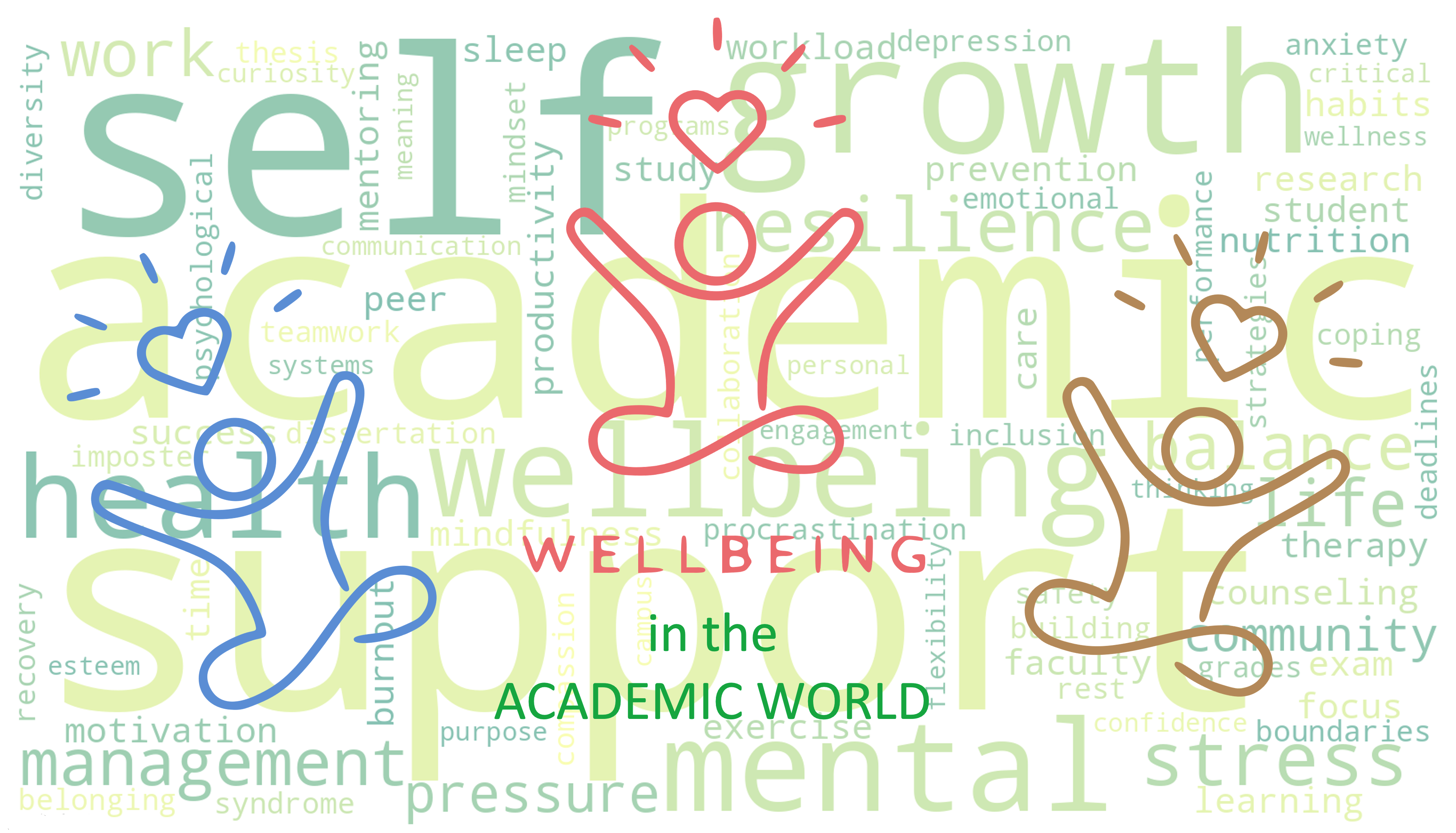
Disclaimer. This survey has collected sensitive personal data (experiences of harassment and discrimination, mental health, and demographic characteristics including sexual orientation). Before the full dataset or detailed breakdown is released to the public, it will need to clear an institutional ethics and data-protection review. This version is a public-safe summary: it sticks to aggregate, large-group statistics and leaves out any breakdown small enough that it could identify an individual or a small subgroup of respondents. It also sticks strictly to the survey's full sample; every figure is drawn from the full N = 246 respondents. This report is a preliminary summary of headline findings, not as the cleared, publishable dataset. The “Wellbeing” image was created with ChatGpt.
Acknowledgements
We are grateful to Prof. Kay Guccione (University of Glasgow) and Prof. Cormac Taylor (University College Dublin) for their helpful comments and suggestions on the FEBS survey. We would like to thank the FEBS Education Ambassadors, the members of the FEBS Junior Section, and Prof. Riccardo Miggiano, Chair of the FEBS Careers of Young Scientists Committee, for their contribution in distributing the survey link.
References
[1] Levecque, K., Anseel, F., De Beuckelaer, A., Van der Heyden, J., & Gisle, L. (2017). Work organization and mental health problems in PhD students. Research Policy, 46(4), 868–879.
[2] Evans, T. M., Bira, L., Beltran Gastelum, J., Weiss, L. T., & Vanderford, N. L. (2018). Evidence for a mental health crisis in graduate education. Nature Biotechnology, 36(3), 282–284.
[3] Woolston, C. (2019). PhDs: the tortuous truth. Nature, 575(7782), 403–406.
[4] Guthrie, S., Lichten, C. A., van Belle, J., Ball, S., Knack, A., & Hofman, J. (2017). Understanding mental health in the research environment: A rapid evidence assessment. RAND Corporation. (Also published as Rand Health Quarterly, 7(3), 2, 2018.)
The top “Wellbeing” image was created with ChatGpt.