The power of public engagement in fundamental research
Earlier this year I was at an international engagement conference where I heard someone say, “but why should the public care about fundamental research when it doesn’t have a direct impact on their life?” and I gasped.
“Because without fundamental research there wouldn’t be any practical applications”, I wanted to shout, but instead I sat and pondered why a senior academic had that opinion of their own research…
Fundamental research, often referred to as basic or pure research, forms the bedrock of scientific advancement. It is the pursuit of knowledge to understand the underlying principles of the natural world. While fundamental research may not always yield immediate practical applications, it plays a crucial role – as one of the puzzle pieces in a giant jigsaw – in shaping the course of scientific progress.
However, the number of fundamental researchers who feel that they, and their work, offers nothing to the public is alarming. But my question to them is: why would their research be funded by public money if the need wasn’t clear?
To me it is very clear: there couldn’t be any real-life application of research without the enormous body of knowledge which has been generated by fundamental scientific research. If we don’t talk about the scientific process as a whole, including the generation of fundamental scientific knowledge, with the public, how will we ever gain their trust? How will we therefore ensure uptake of the real-life applications? Therefore, I truly believe that one key factor that can greatly enhance the impact of fundamental research is public engagement.
What is public engagement?
“Public engagement describes the myriad of ways in which the activity and benefits of higher education and research can be shared with the public. Engagement is by definition a two-way process, involving interaction and listening, with the goal of generating mutual benefit” (National Co-ordinating Centre for Public Engagement, NCCPE).
Many people reading this will immediately think, “but I don’t have time to spend hours running activities at a science festival with children” or, “but I‘m an introvert and I don’t like spending time with lots of people”… and my answer to you is, you don’t have to. Public Engagement is an umbrella term for all sorts of activities, and there genuinely is something for everyone as you can see here:
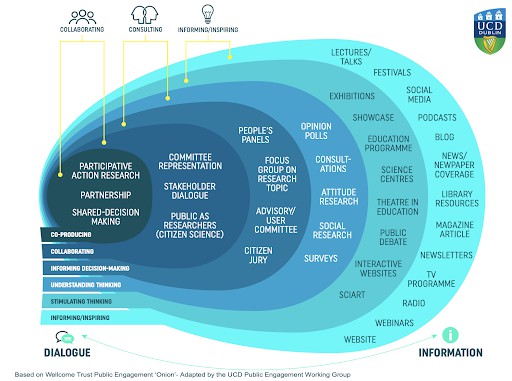
Diagram adapted by University College Dublin from the Wellcome Trust Public Engagement Onion version, representing in concentric layers the different types of activities under public engagement.
One sub-group of the public are people with lived experience of a specific disease or disorder, and these seem to be the scariest group of people who fundamental researchers talk to. They’ll say things like, “but nothing I’m doing will really impact them” so I’d like to share a project which I hope will change your mind…
From theory into practice
In 2020, I joined the MRC-University of Glasgow Centre for Virus Research (CVR) as the Engagement and Communications Coordinator. Most of my time and energy was taken up by COVID-19 communications, and this got me thinking about all the other viruses which were still out there, and all the people who were affected. The CVR has historically been a fundamental virology unit, with few clinical researchers, but the COVID-19 pandemic saw a lot more of the work going from bench to bedside. This meant a lot more of our researchers were seeing the application of their work and were fired into the limelight more than before. We were suddenly involved in clinical trials and opened CRUSH – an Antiviral Drug-Screening and Resistance Hub.
With this quick dive into the clinical world, it meant that soon our researchers would have to embark on Patient and Public Involvement (PPI) to access certain funding streams. PPI entails research being carried out ‘with’ or ‘by’ members of the public, rather than ‘to’, ‘about’ or ‘for’ them. Now, this is a very long way away from fundamental research, so I wanted to prepare them by creating the steppingstone of patient engagement.
Luckily, the CVRs Associate Director at the time, Professor John McLauchlan had a long-term relationship with the sexual health charity Terrence Higgins Trust (THT) and had just been awarded a small pot of funding by the Medical Research Council (MRC). This funding was to run a visit for people with lived experience of Hepatitis C and/or HIV. However, because of the pandemic, we had to redirect this funding and approached THT and asked what they wanted to know and do. So, in January 2021, John and my PhD intern Tia Salter joined a call with about ten THT service users to decide.
This conversation helped us understand a few things:
- That service users really wanted to know how their blood samples were used in research.
- That service users weren’t confident speaking to research staff and students.
- That service users really enjoyed artistic approaches and projects.
Shortly after this call, I contacted Alice Haskell, an amazing artistic facilitator I had worked with in a previous role at University College London (UCL), about running a session exploring the journey of a blood sample. We successfully trialled this and it was clear that the service users were gaining confidence and wanted to engage with us more. I then approached the other researchers at the CVR working on blood-borne viruses (BBVs) such as Hepatitis C and HIV to brief them on the project. It didn’t take long for someone to say, “but, nothing I do will ever benefit these people” and, “what if I say something to upset them?”. It became obvious that the researchers were as nervous about engaging with the service users, as the service users were with them.

The journey continues
These conversations shaped a successful grant application to the MRC Public Engagement Seed Fund written by Tia, and thus, the Unseen Hands project was born. (You can access the funding application here to see how we wrote it – keep scrolling for the full evaluation and what changed). This project aimed to bring fundamental virologists together with people living with a BBV to encourage engagement, participation and sharing individual lived experience to connect with and inform research practice. We hoped to break down barriers and encourage communication to address and reduce stigma and discrimination.
Through this project we co-developed a series of videos, with Fynn Elkington from FoSho Studios (which you can watch here), exploring the different ways we use blood samples in our research at the CVR. We did this in consultation with service users to ensure the content responded to their needs. To ensure we were considerate of language and stigma we ran a series of workshops including:
“Difficult Conversations” to prepare researchers for discussing lived experience with the service users.
“Language and Stigma” where both groups came together to discuss stigmatising language and situations they have experienced. This demonstrated that it’s not only the researchers who could use stigmatising language, but that words like “nerd” and “boffin” felt quite stigmatising for researchers. This session was also poignant because one service user said the following quote:
“We all live with HIV or Hepatitis really, don’t we? Whether you are one of us, getting up and taking your pills to control your virus, or whether you a researcher studying a virus in a laboratory. We probably all get the same bus to and from work every day, and go home and watch Coronation Street on the tele”.
It was also great to see both groups gaining in confidence throughout the session, including a very brave interaction towards the end:
Researcher: “So, why do you think I do research?”
Service user: “Because you want to find a cure for Hepatitis?”
*Large pause*
Researcher: “No actually, I’m just really curious about how viruses enter cells”.
Service user: “Yeah… but what you find out might mean that someone else down the line can cure Hepatitis, right?”
Researcher:

This had genuinely not crossed their mind. The conversation then went onto how everyone in the room was part of the same puzzle, and how everyone plays a role in the fight against blood-borne viruses, which spurred the development of the next phases of the project.
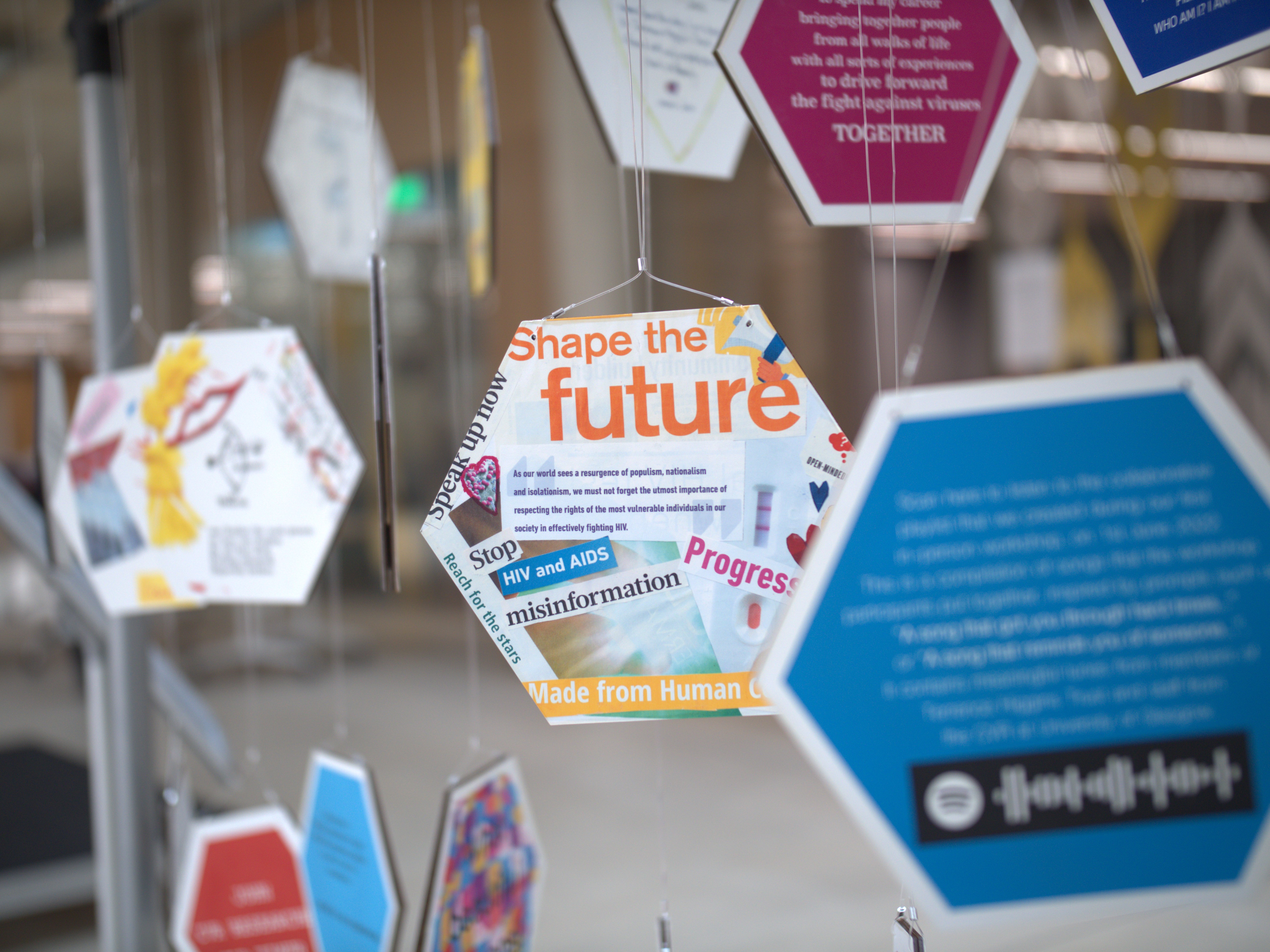
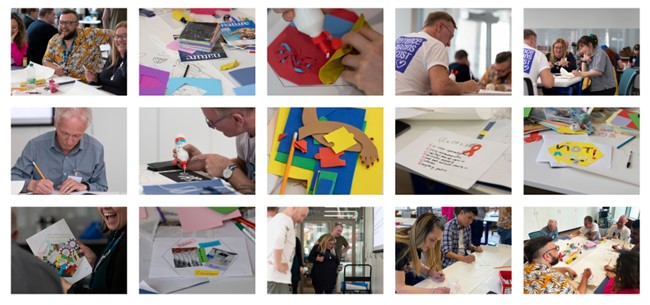
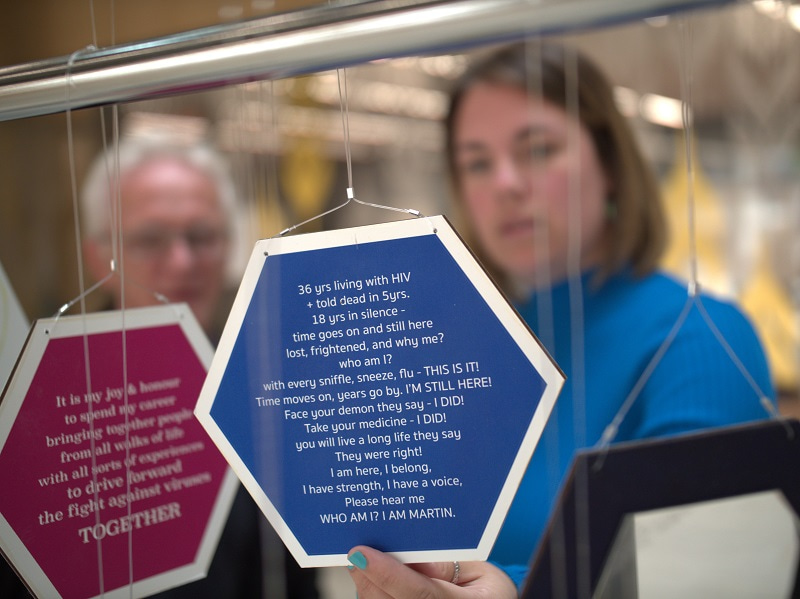
“Puzzle Pieces” was our first in-person workshop bringing everyone together to explore the parts we play as individuals in the fight against blood-borne viruses. Alice Haskell returned to facilitate and led everyone through a session designing a hexagon puzzle piece which represented their part. She turned these into an exhibition which was installed in the CVR in May 2023.
Making an impact
The most powerful thing for me, was how people who had previously not engaged with the charity or the project had come along to the workshop. One specific person, who was very nervous at the start, produced a tile which said “Not Alone”, and by the end of the day was chatting and hugging everyone. (You can read the list of things we did in our workshops to make people comfortable on page 18 of our evaluation here).

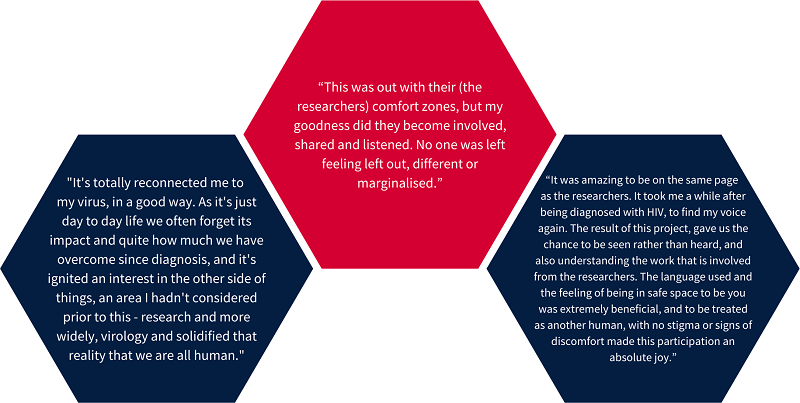
And the day wasn’t just impactful for our service users… but for our staff and students too, who shared the following comments:

“Future of BBV research, support and care” was run in September 2022, where we brought everyone back together, as well as inviting other supporting charities, researchers and funding bodies. We developed an action-led manifesto for the future of BBV research & support, which puts lived experience at its heart.
You can watch our video from the day here which shows the power of this partnership:
We also developed a video sharing our manifesto:
You can also read an article in the Scotsman by Dani Garavelli:
There’s only so many times you can hear 'go away and die': Why is there still a stigma around living with HIV? | The Scotsman
We couldn’t have imagined the impact this project would have when we started, and the strength of this partnership was demonstrated in the response to our surveys:
Since the final workshop, John has (finally) retired and Dr Joe Grove has enthusiastically taken over as academic lead on the project. Joe has also been seeking ways to recognise the contributions of people with lived-experience in his research papers and projects. The CVR was awarded a further 7 years of funding, with the Unseen Hands video being used (and commended) in the final presentation to the panel.
I have moved onto a new role at the University of Edinburgh and have been ‘rounding the troops’ to continue this project as a wider collaboration between the two universities, and including Edinburgh-based charity Waverley Care. I have also been awarded a Churchill Fellowship to explore ways we can improve equity in the research, support and care we offer in Scotland.
Start here
So, if you find yourself thinking about why you should engage the public in fundamental research ask yourself the following question:
“Why did I decide to go into research?”
And if you can’t remember, find yourself a public audience to answer the question for you. But if you find yourself thinking, “but I just wanted to do research because doing research is cool” then remember what I said earlier. From fundamental to translational to clinical, every researcher plays a part in the huge puzzle of science. There are people who want to share your curiosity, drive, and enthusiasm to uncover parts of the natural world never discovered before. But how will they know, if you don’t let yourself out of your comfort zone and go and find them?
Resources & organisations available to help you get started – a lot of these folks offer free training or very low-cost membership:
- CVRs Engagement website (more information)
- National Coordinating Centre for Public Engagement (NCCPE)
- BIG STEM Communicators Network: https://www.big.uk.com/
- Berlin School of Public Engagement and Open Science (all available worldwide)
- European Science Engagement Association
- Scottish Public Engagement Network (ScotPEN)
- London Public Engagement Network
- COMMunity (research presentation skills network & training)
Find me online:
www.fayewatson.co.uk
Twitter: @fayewatson94
LinkedIn: https://www.linkedin.com/in/faye-watson-84836b88/
All images by MRC-University of Glasgow Centre for Virus Research (CVR).