If you’re acquainted with the scientific literature, whether it’s papers, grants, or press releases, chances are that the following word formulae will be very familiar:
- “Disease X is a global threat, affecting Y million people and causing Z deaths annually.”
- “Pathogen X is the causative agent of disease Y, which affects Z million people.”
- “Gene X is responsible for syndrome Y, which is characterised by Z nasty features” (such as mental retardation, decreased life expectancy, physical disability).
- “Protein X is associated with cancer Y, which kills Z” (you don’t need bodycounts with cancers – everyone knows they kill a lot of people).
We all do it. We’re all encouraged to do it. And we all go along with it. When we’re writing about our own work, we emphasise the disease angle even if it’s of little direct relevance to our practical work.
Why?
Because there is a widespread perception – and I can’t really say whether it comes from the scientific community, the funding bodies, politicians, or society at large – that if you’re not working on something that makes humans sick, then your research is not terribly important.
And as with politics, there’s a sense that people (i.e. the taxpayer) will support you if you can (i) frighten them about an external threat, and (ii) present yourself as the person best able to save them from it.
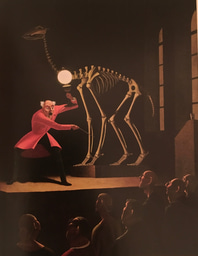
This is a Faustian pact, pure and simple. It’s a fair bet that once you’ve started hyping your work as the way to a cure for disease X/syndrome X/cancer, you’ll improve your chances of securing funding – even if it’s just due to the number of options that become available. I vividly remember a colleague bouncing into the lab during my PhD and waving a paper – “The protein I work on has just been implicated in tumour migration!” he exulted, “Do you realise what this means? Now we can start applying for cancer money!” (And he was right)
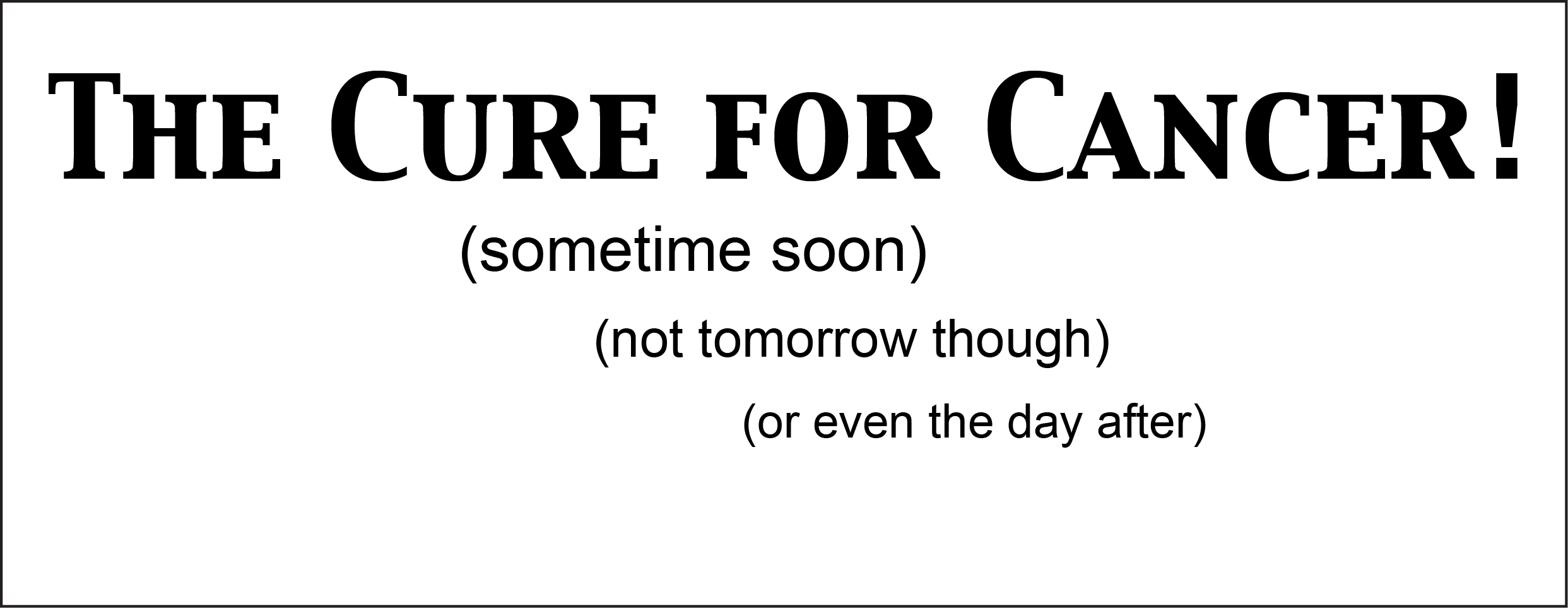
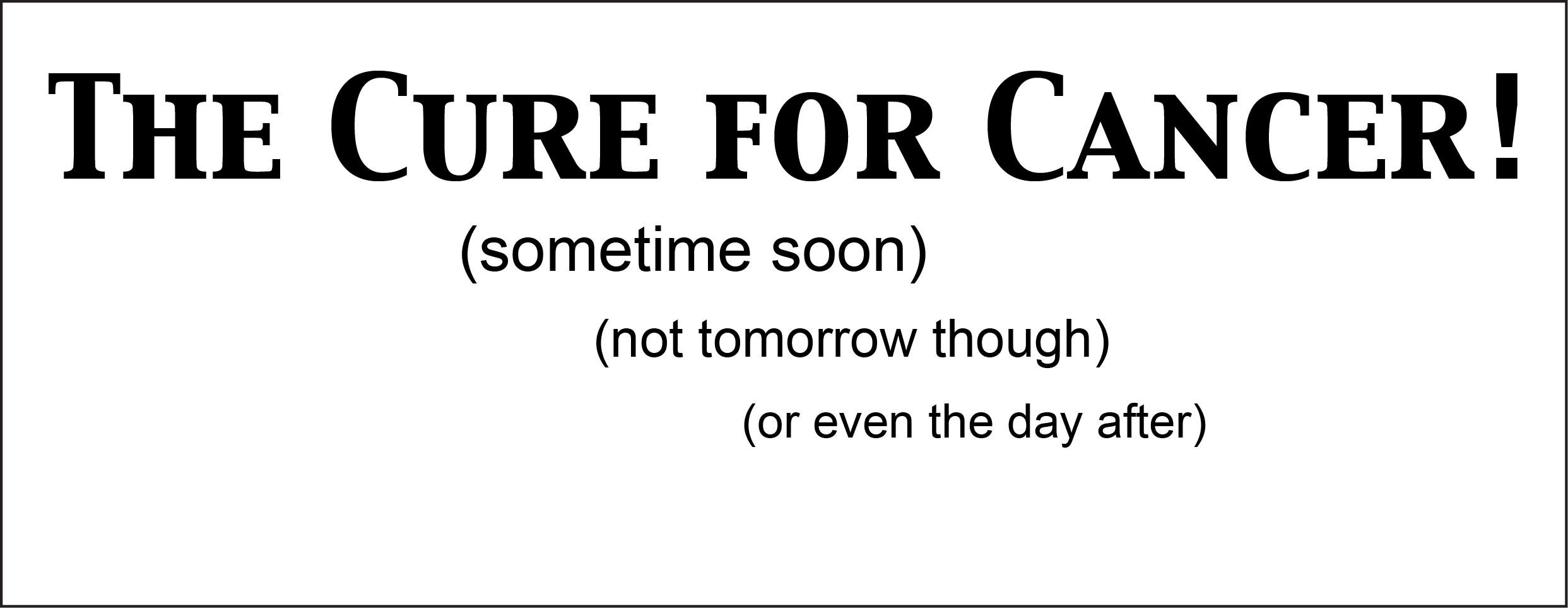
But as soon as you’ve made that pact, there will – just as with Faust – come a day of reckoning. And with public accountability becoming more and more of a requirement for science funding, it’s likely that those inquisitions are going to become more frequent. All those decades of promising cures have created expectation, then puzzlement, and increasingly disillusionment. It’s already a standing joke that when you tell someone you’re a scientist, the question that follows (which used to greet me every time I walked into the pub) is: “Haven’t you cured cancer yet?”.
‘Cos y’see, while we say we’re working on a cure for disease X/syndrome X/cancer, most of us actually aren’t – focusing on a cure, that is. What we want to do is understand the disease/syndrome/cancer. Now, that understanding will eventuallyy lead to new drugs, new therapies, and maybe even a miracle cure, but in the timeframe of individual grants (or even individual careers) that’s pretty unlikely. Very, very few scientists ever see a new drug clear clinical trials and hit the market as a direct result of their research into the basic biology of the process.
It’s unlikely not because of a lack of effort, but because these things take time. It takes a long time to do a good job in science, because you are at the absolute limit of human knowledge, and obtaining firm evidence of things is a slow process. There may be a temptation to cut corners or race ahead, but it’s becoming increasingly clear that such approaches primarily bring about reproducibility problems in the literature – something that’s now a real problem for the well-funded, densely-populated cancer field.
Solving the world’s problems is important of course, but discovery cannot be legislated. The priority with science should be to do good research, and if that’s the case then the rewards will follow – sometimes, and significantly, from the most unexpected places. High-quality work does not necessarily have to have an immediate link to human health, and scientists need to be more confident about emphasising their worth rather than emphasising their relevance.
Conflating the understanding of a process with its cure is hype, and hyping something creates an expectation that can be hard to contain (for both movies and the war on cancer). We as scientists must justify ourselves, but not by selling our souls for a fast buck.
Originally published on Total Internal Reflection - HERE.

Ex-academia, now in MedComms. I write a blog called Total Internal Reflection about the human side of science. Postings are generally either opinion/commentary (either serious or silly) or "How To" pieces aimed at improving young scientists' soft skills.
A longer biography and manifesto are on the blog here.