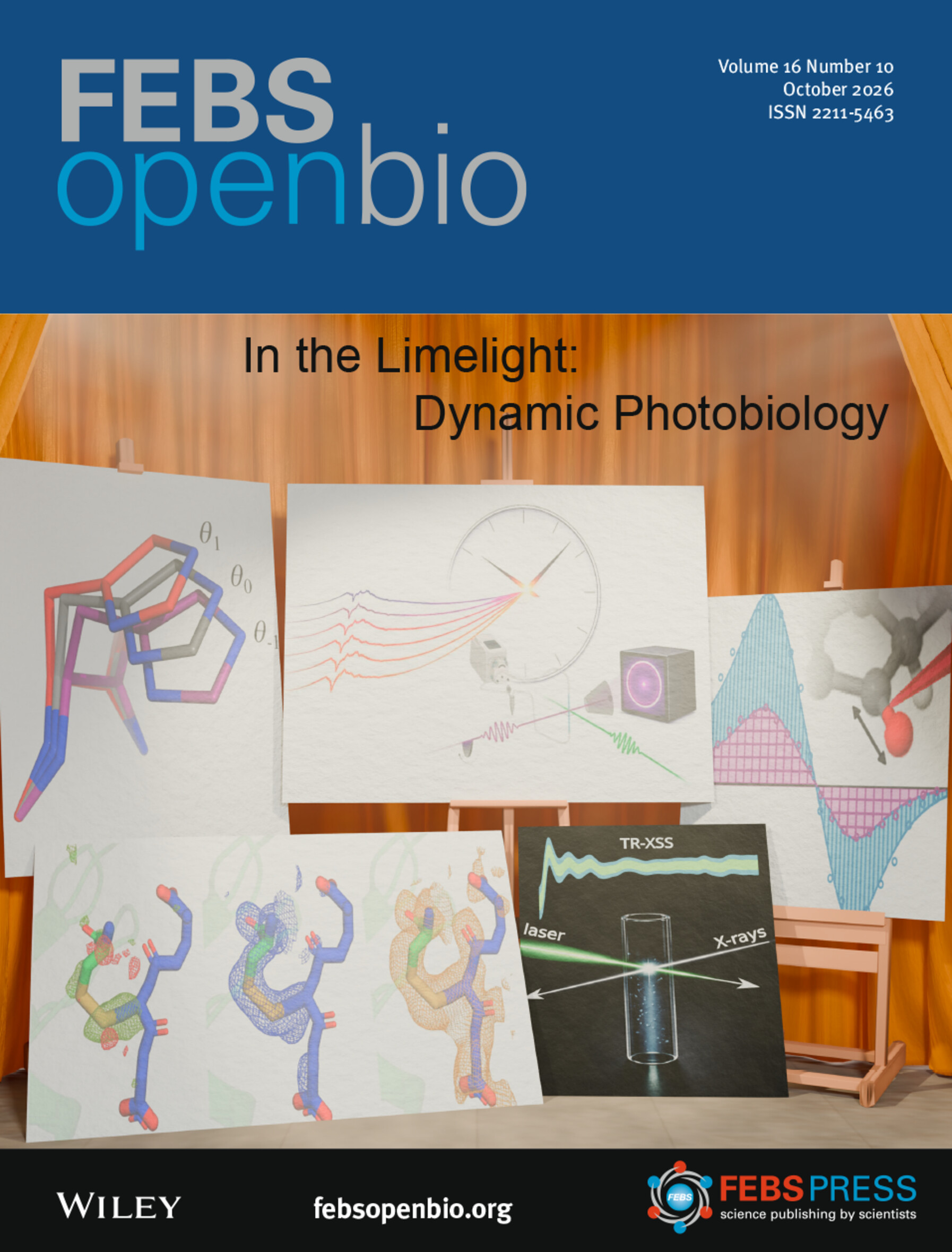

The function of a protein is heavily dependent on its structure, and though science has revealed proteins to be nowhere near static in nature, our understanding of them has traditionally been limited to observing their structures through static snapshots, revealing only a glimpse into the dynamic shifts that determine their function. For proteins that sense and respond to light, the absorption of a single photon can trigger a cascade of structural changes. Techniques such as time-resolved spectroscopy and X-ray solution scattering offer ways to investigate these changes as they unfold, revealing the kinetics of light-triggered intermediates and generating models of the conformational changes that accompany them. However, neither technique on its own can fully capture the complexity of protein dynamics.
Bringing such approaches together is the focus of FEBS Open Bio’s latest ‘In the Limelight’ issue, Dynamic Photobiology. Guest edited by Sofia M. Kapetanaki (Lund University, Sweden), Antoine Royant (Institut de Biologie Structurale, Grenoble, France), and Briony A. Yorke (University of Leeds, UK), this issue explores the synergy of experimental techniques, provides practical guidance for early-career researchers, and addresses some of the key experimental challenges in the field of Dynamic Photobiology.
The issue begins with a guest editorial introducing five research protocols that each highlight different methods of exploring light-induced protein dynamics:
1) Zahn and Heyne present a polarization-resolved femtosecond Vis/IR spectroscopy approach for detecting weak signals in biological samples using minimal sample volume.
2) A protocol by Matteo Levantino explores ways to optimise photoexcitation conditions for time-resolved X-ray solution scattering experiments.
3) Sabzian-Molaei et al. introduce a workflow for light-triggered TR-XSS experiments that span data collection, data processing, kinetic analysis, and structural refinement.
4) Hill et al. put forward methods for assessing small conformational changes and low-occupancy states in time-resolved serial crystallographic data.
5) Finally, a protocol by Hong et al. presents the difference electron density correlation coefficient real space refinement algorithm (dFoCC) as an approach for evaluating amino-acid conformations in time-resolved serial femtosecond crystallography data.
We invite you to read the full issue here.